
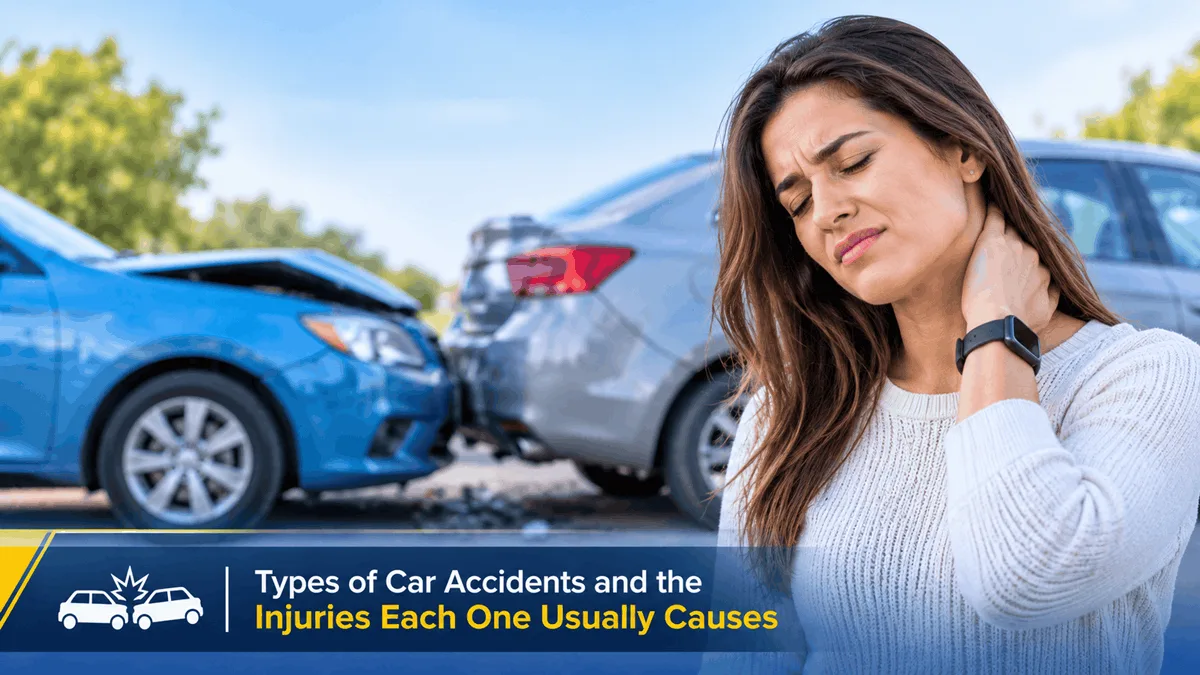
Ask ten people who’ve been in a wreck where it hurts, and you’ll get ten different answers. One person’s neck is stiff. Another can’t take a deep breath without a sharp pain in the ribs. A third walked away fine and then woke up two days later with a headache that won’t quit. Much of that difference comes down to how the crash happened. The types of car accidents people get into, from rear-end to rollover, each push the body in a different direction. And that direction shapes which injuries tend to show up. Here’s how each crash type usually affects the body, and what that means for your recovery.
The main types of car accidents are rear-end collisions, side-impact (T-bone) crashes, head-on collisions, sideswipes, rollovers, low-speed fender-benders, and crashes involving large trucks. Each one moves the body in a predictable direction. So each tends to produce its own injury pattern, from neck strain in rear-end crashes to rib and pelvic injuries in side impacts.
Your body keeps moving in the original direction of travel when a vehicle suddenly stops, speeds up, or gets pushed sideways. Seat belts, airbags, and headrests limit that movement, but they also create their own pressure points. Knowing your crash type helps a physical therapist predict which tissues took the load and what to test first.
7 Types of Car Accidents and How Each One Injures the Body
Each of these seven crash types loads the body in a different direction. That’s why the same speed of impact can cause very different injuries. Here’s what typically happens in each one.
1. Rear-End Collisions
Rear-end collisions are widely reported as the most common type of crash. When you’re hit from behind, your seat pushes your torso forward while your head lags behind for a split second, then snaps forward. That S-shaped motion strains the muscles, ligaments, and small joints of the neck. It’s the classic whiplash pattern, and upper back tightness and headaches often come with it. Our guide to neck pain after a car accident explains it in detail.
2. Side-Impact (T-Bone) Collisions
Side-impact crashes usually happen at intersections, when one car strikes the side of another. The door offers far less crush space than the front or rear of a vehicle. If you’re on the side that’s hit, shoulder, rib, pelvis, and hip injuries are common. So is a head impact against the window or pillar. People on the far side often get a sideways neck strain instead.
3. Head-On Collisions
Head-on crashes involve the highest combined forces because both vehicles are moving toward each other. The body is thrown forward into the seat belt and airbag. That’s why we tend to see sternum and rib bruising, a frequent source of chest pain after a car accident. Wrist and forearm injuries from gripping the steering wheel and knee injuries from the dashboard are common too. Fractures are more common in this crash type than in most others.
4. Sideswipe Collisions
A sideswipe happens when two vehicles traveling side by side scrape against each other, often during a lane change. The direct impact is usually lighter than a T-bone, but the sudden sideways jolt can still strain the neck and upper back. Drivers also tend to tense up and jerk the wheel, which can irritate the shoulders and wrists. The bigger danger is a secondary crash if a driver overcorrects.
5. Rollover Accidents
Rollovers are among the most violent crash types. The vehicle may hit the ground several times, and the roof can be pushed inward. Occupants get thrown in multiple directions at once. Head injuries, spinal injuries, shoulder injuries, and fractures are all more likely. Taller vehicles like SUVs and pickups are more prone to rolling over than lower cars.
6. Low-Speed Fender-Benders
Low-speed collisions in parking lots or stop-and-go traffic often leave little visible damage on the car, and that’s exactly why people underestimate them. Even a minor bump can whip the head and neck. The risk goes up if you were looking down or turned to the side at impact. Neck strain, upper back pain, and headaches are the usual complaints, and they often build over the next day or two.
7. Crashes Involving Large Trucks
Crashes with 18-wheelers and other heavy trucks are dangerous mainly because of the size and weight difference. A passenger car absorbs nearly all of the force. These crashes frequently involve more than one impact, such as being pushed into another vehicle or a barrier. Multiple injuries at once are common, including back injuries, herniated discs, fractures, and concussions.
Crash Type vs. Injury Pattern at a Glance
This table matches each of the main types of car accidents to the way the body moves and the injuries physical therapists most often evaluate afterward.
| Crash type | How the body moves | Injuries we commonly see | Body areas a PT usually checks first |
|---|---|---|---|
| Rear-end | Torso pushed forward, head snaps back then forward | Whiplash, upper back strain, headaches | Neck, upper back, shoulder blades |
| Side-impact (T-bone) | Body thrown sideways toward the impact | Shoulder, rib, pelvis, and hip injuries; head impact | Shoulder, ribs, hip, sideways neck motion |
| Head-on | Body thrown forward into belt and airbag | Chest bruising, wrist and knee injuries, fractures | Chest wall, wrists, knees, lower back |
| Sideswipe | Sudden sideways jolt | Neck and upper back strain, shoulder and wrist strain | Neck, shoulders, grip strength |
| Rollover | Multiple directions, repeated impacts | Head, spine, and shoulder injuries; fractures | Full spine, shoulders, balance |
| Low-speed | Short, quick whip of the head and neck | Neck strain, headaches | Neck motion, upper neck joints |
| Large truck | Heavy force, often more than one impact | Back and disc injuries, fractures, concussion | Spine, nerve function, balance |
Treat this table as a starting point, not a diagnosis. Plenty of patients have injuries that don’t fit their crash type, which is why a hands-on evaluation matters. For a closer look at the injuries themselves, our breakdown of common car accident injuries covers the signs of each one.
Why Two People in the Same Crash Get Hurt Differently
Two people in the same crash often have different injuries. Body position, seat location, and bracing all change how force travels through the body. In our clinics, it’s common to treat a driver and passenger from the same collision who have almost nothing in common on their evaluations. These factors usually explain why.
- Head position at impact. If your head was turned to check a mirror or talk to a passenger, the neck absorbs force at an angle. That tends to cause more one-sided pain.
- Bracing. Drivers who see the crash coming often brace hard on the steering wheel or brake pedal. That can spare the neck but strain the shoulders, wrists, or ankles.
- Seat position. In a side-impact crash, the person nearest the point of impact usually takes more direct trauma than the person on the far side.
- Headrest height. A headrest set too low lets the head travel farther backward in a rear-end crash.
- Seat belt path. The belt crosses one shoulder, so chest and shoulder bruising is often worse on that side.
- Prior injuries. An old back or neck problem can flare up even after a relatively light crash.
What Your Crash Type Tells Your Physical Therapist
Your crash type helps a physical therapist decide which structures to test first, but it doesn’t replace a full evaluation. The details you remember from the moment of impact are some of the most useful information you can bring to your first visit.
Try to note the direction of impact and where you were sitting. Also note whether the airbag deployed, which way your head was facing, and whether you braced. Also write down when each symptom started. A licensed physical therapist uses that history alongside range-of-motion testing, strength testing, and nerve checks to build a plan around what’s actually injured. Our auto accident injury treatment program follows that same approach, starting with the evaluation and moving from pain relief to full function.
One honest limitation: the crash type doesn’t tell anyone how long recovery will take. A low-speed crash can leave someone with neck pain for weeks, while a person in a more dramatic collision may recover faster. How soon treatment starts, your general health, and any older injuries usually matter more than the type of crash.
Frequently Asked Questions
What is the most common type of car accident?
Rear-end collisions are widely reported as the most common type of car accident. They often happen in stop-and-go traffic, at red lights, and when a driver is distracted or following too closely. They’re also one of the most common causes of whiplash and the neck and upper back pain that comes with it.
Which type of car accident causes the most serious injuries?
Head-on collisions and rollovers tend to cause the most serious injuries because of the forces involved. Head-on crashes combine the speed of both vehicles, and rollovers throw occupants in several directions at once. Side-impact crashes are also high-risk for the person on the struck side, since doors offer little crush space.
Can a low-speed car accident cause a real injury?
Yes. A low-speed crash can still whip the head and neck fast enough to strain muscles and ligaments. That’s especially true if your head was turned or you didn’t see the impact coming. Little visible damage on the car doesn’t mean your body escaped harm. Pain from these crashes often shows up a day or two later.
What is a T-bone accident?
A T-bone accident is a side-impact collision where the front of one vehicle hits the side of another, forming a “T” shape. These crashes usually happen at intersections. People on the struck side commonly injure the shoulder, ribs, pelvis, or hip, and may hit their head against the side window.
Does the type of car accident affect recovery time?
The crash type affects which injuries are likely, but it isn’t the best predictor of recovery time. The specific injury, how soon you start treatment, your age and fitness, and any previous neck or back problems usually play a bigger role. Mild soft-tissue strains often improve within weeks, while disc injuries can take months.
Not Sure What Your Crash Did to Your Body? Get It Evaluated
No matter which of these types of car accidents you were in, the safest next step is a proper evaluation. At Advance Physical Therapy, a licensed physical therapist looks at how your crash happened and tests the areas that took the force. Then they build a customized plan around what’s actually injured.
You don’t need a referral to get started, and we accept PIP and work with attorney liens and Letters of Protection. We’ve been treating Texans after car accidents since 1999. Book an evaluation at the clinic nearest you and find out what’s really going on.