
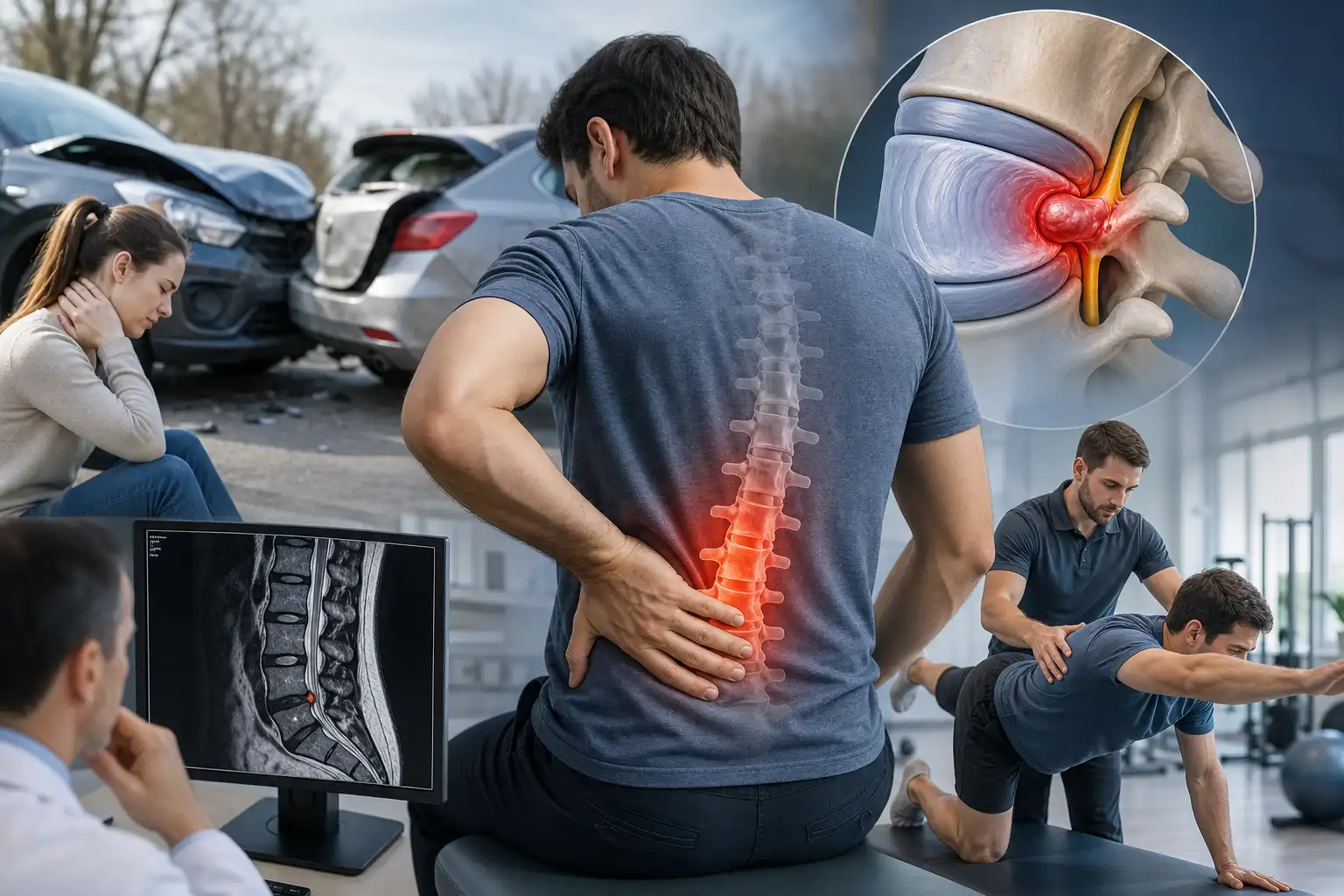
The crash might have seemed minor. Then, a day or two later, a sharp pain started shooting down one leg, or your fingers began tingling every time you looked down at your phone. That pattern isn’t ordinary soreness. It’s often one of the first signs of a herniated disc from a car accident. Spinal discs are the cushions between your vertebrae, and a collision can tear a disc’s tough outer wall in a fraction of a second. When that happens, the problem can involve a nerve, not just a tight muscle. Knowing which symptoms point to a disc, when an MRI makes sense, and what physical therapy actually does can save you weeks of guessing.
Yes, a car accident can cause a herniated disc. The sudden compression and twisting forces of a collision can tear a spinal disc’s outer ring, letting the soft inner material press on a nearby nerve. It most often affects the lower neck or lower back and can cause radiating arm or leg pain, numbness or weakness.
Most crash-related disc herniations improve without surgery. An MRI is usually saved for red-flag symptoms or for pain that hasn’t improved after about six weeks of conservative care. Physical therapy focuses on calming the irritated nerve, restoring movement, and rebuilding the strength that protects the disc, so you can sit, drive and work again without flare-ups.
How Does a Car Accident Cause a Herniated Disc?
A car accident causes a herniated disc when the spine is compressed, bent and twisted faster than the disc can absorb the load. Each disc has a fibrous outer ring, the annulus fibrosus. Inside sits a gel-like center called the nucleus pulposus. Enough sudden force can tear the ring and push that inner material outward.
The direction of the crash shapes where the damage lands. In a rear-end collision, the neck snaps back and then forward. That loads the lower cervical discs. In a frontal crash, a seated driver’s lower back bends forward against the lap belt while the spine is compressed. Side impacts add rotation, which is especially hard on discs under load.
Herniated Disc Symptoms: Neck vs Lower Back
Herniated disc symptoms depend on which level of the spine is injured, because each disc sits beside a specific nerve root. A cervical disc usually sends symptoms into the shoulder, arm and hand. A lumbar disc sends them into the buttock, leg and foot. Here are the patterns physical therapists look for.
| Symptom pattern | Cervical (neck) disc | Lumbar (lower back) disc |
|---|---|---|
| Most commonly injured levels | C5–C6 and C6–C7 | L4–L5 and L5–S1 |
| Where pain travels | Shoulder blade, upper arm, forearm | Buttock, back of the thigh, below the knee |
| Typical numbness or tingling | Thumb and index finger (C6), middle finger (C7) | Top of the foot and big toe (L5), outer foot and heel (S1) |
| Weakness you might notice | Weaker grip, trouble lifting the arm overhead | Foot catching when walking, trouble rising onto your toes |
| What usually makes it worse | Looking down, turning your head toward the painful side | Sitting, bending forward, coughing or sneezing |
| Name for the nerve problem | Cervical radiculopathy | Lumbar radiculopathy (sciatica) |
When neck disc material presses on a nerve root, the result is called cervical radiculopathy. In the lower back, the same process is the most common cause of sciatica. That’s why sciatica after a car accident is often a disc problem rather than a pulled muscle.
In practice, a few clues separate a disc injury from a simple strain. Pain that travels past the elbow or knee points toward a nerve. So does pain that spikes with a cough or sneeze. Numbness that follows the same strip of skin every time is another tell. A muscle strain tends to stay near the spine and ease with heat and gentle movement.
What to Do First: Red Flags and the First Few Days
Get emergency care the same day if you have any of the red flags below. If you don’t, the best first step is gentle, regular movement rather than bed rest. A small number of crash-related disc injuries compress the spinal cord or the nerve bundle at the base of the spine, so go to the ER, not a therapy clinic, if you notice any of these:
- Numbness in the groin, inner thighs or buttocks (the “saddle” area)
- New trouble controlling your bladder or bowels
- Weakness that keeps getting worse, such as a foot that drags or a hand that keeps dropping things
- Leg pain, numbness or weakness on both sides at once
- Clumsy hands, trouble with buttons, or new balance problems after a neck injury
The first two signs can point to cauda equina syndrome, a surgical emergency. The last can signal pressure on the spinal cord in the neck. These problems are rare. Still, they’re why every physical therapy evaluation after a crash starts with a neurological screen.
If none of those apply, keep moving within your comfort range. Old advice told people to lie still until the pain passed. Current evidence shows that staying lightly active usually leads to faster recovery and less stiffness. Here’s what tends to help, and what tends to make things worse:
| Usually helps | Usually makes it worse |
|---|---|
| Short, easy walks several times a day | Staying in bed for days |
| Getting up from sitting every 20 to 30 minutes | Long drives or hours on the couch without a break |
| Positions that ease the arm or leg symptoms, like lying on your back with knees bent | Bending and twisting at the same time, especially while lifting |
| Heat or ice, whichever feels better, for 15 to 20 minutes | Forcing stretches that send pain further down the limb |
| Writing down when symptoms change and what triggers them | Waiting weeks to see if numbness goes away on its own |
A simple rule from the clinic: if an activity makes pain spread further into your arm or leg, stop it. If it pulls the pain back toward your spine, it’s usually a good sign.
When Should You Get an MRI After a Car Accident?
An MRI after a car accident is usually needed right away only when red-flag symptoms are present. Otherwise, imaging is typically considered when weakness is getting worse, or when arm or leg symptoms haven’t improved after about six weeks of conservative care.
Here’s the part most articles leave out. Disc changes show up on MRI in plenty of people who have no pain at all. A systematic review in the American Journal of Neuroradiology found disc bulges in 30% of pain-free 20-year-olds and 84% of pain-free 80-year-olds. A scan by itself can’t show whether a finding is new or whether it’s the source of your symptoms.
That’s why the scan has to match the exam. If an MRI shows an L5–S1 herniation and your exam shows weakness and numbness in the S1 pattern, the picture is clear. If the two don’t line up, the image may be showing an older change. We explain a related point in why an MRI isn’t always the solution for whiplash pain.
| Your situation after the crash | Typical next step |
|---|---|
| Any red-flag symptom listed above | ER evaluation and urgent imaging |
| Arm or leg weakness that is getting worse | Prompt physician visit to discuss imaging |
| Radiating pain or tingling with stable strength | Start physical therapy and reassess at 4 to 6 weeks |
| Neck or back pain with no arm or leg symptoms | Physical therapy; imaging is rarely needed early |
| Little or no improvement after about 6 weeks of care | Ask your physician about an MRI and a specialist referral |
One honest trade-off: if you’re pursuing an injury claim, your attorney may want imaging sooner than your symptoms call for it. That’s a decision for you, your physician and your attorney. It doesn’t change what the exam shows or how treatment should begin.
How Physical Therapy Treats a Herniated Disc From a Car Accident
Physical therapy treats a crash-related herniated disc by calming the irritated nerve first, then rebuilding the strength and movement that protect the disc. Most people don’t need surgery. A systematic review in Clinical Rehabilitation found that lumbar disc herniations often shrink on their own, and larger extrusions regressed far more often than simple bulges.
Evaluate the Nerve, Not Just the Pain
The first visit with a licensed physical therapist includes a neurological screen. That means reflexes, sensation along each nerve’s skin map, and strength testing for key muscle groups. The straight leg raise (lower back) and Spurling’s test (neck) help confirm whether a nerve root is involved. These baseline findings are how progress gets measured later.
Calm the Irritated Nerve
Early treatment looks for a directional preference: a repeated movement or position that pulls symptoms out of the limb and back toward the spine. Therapists call this centralization. It’s one of the more reliable early signs of recovery. Nerve glides, hands-on manual therapy, and better sleeping and sitting positions help settle the nerve down.
Rebuild Support and Tolerance
Once symptoms are steadier, the focus shifts to strength. For neck discs, that means the deep neck flexors. For lower back discs, it means trunk and hip endurance. Then come real-life demands: getting in and out of the car, sitting through a commute, lifting at work.
Know What a Typical Recovery Looks Like
How long a herniated disc takes to heal varies, but most people follow a similar arc. Many feel noticeably better within 4 to 6 weeks. Nerve symptoms like numbness and full strength often take longer to settle.
| Timeframe | What usually happens |
|---|---|
| Weeks 0 to 2 | Pain and nerve irritation are at their peak; the focus is calming symptoms and staying gently active |
| Weeks 2 to 6 | Arm or leg pain starts moving back toward the spine; movement and sitting tolerance improve |
| Weeks 6 to 12 | Strength work builds up; most people return to driving, work and normal routines |
| After 12 weeks | If progress has stalled, it’s time to discuss imaging or a specialist opinion with your physician |
Physical therapy doesn’t work for everyone. Surgery is usually considered only when strength keeps declining, when red-flag signs appear, or when pain stays severe despite several weeks of good conservative care. In those cases, your therapist should coordinate with your physician about injections or a surgical consult. For most crash patients, PT is one part of broader auto accident injury treatment rather than the only option on the table.
Frequently Asked Questions
Can a car accident make an old disc problem worse?
Yes. A collision can aggravate a disc that already had age-related wear, even if it never caused symptoms before. What matters clinically is whether your symptoms and exam findings changed after the crash. A prompt, documented evaluation helps show that change, especially if you had no arm or leg symptoms beforehand.
Can a herniated disc come back after it heals?
It can. A disc that herniated once is more likely to flare again, especially with repeated bending and lifting, long hours of sitting, or a return to heavy work too soon. Keeping up the strength and movement habits from therapy after discharge is the most practical way to lower that risk.
Will a herniated disc from a car accident heal on its own?
Often, yes. Herniated disc material can shrink over weeks to months as the body reabsorbs it. Healing on its own doesn’t mean doing nothing, though. Guided movement keeps the nerve calm and prevents protective habits, like refusing to bend, that can keep pain going long after the disc settles.
What’s the difference between a bulging disc and a herniated disc?
A bulging disc spreads evenly past its normal edge, a bit like a tire low on air. A herniated disc has a tear that lets inner material push out at one spot. Herniations are more likely to irritate a nerve, but either one can hurt, and treatment depends on your symptoms rather than the label.
How does a herniated disc affect a car accident claim?
Insurers often argue that a disc finding was there before the crash. Clear records help answer that: an early evaluation, exam findings such as reflex or strength changes, imaging that matches those findings, and steady attendance. Gaps in care raise questions. For legal or settlement specifics, talk with your attorney.
Do I need a referral to start physical therapy in Texas?
Not at Advance Physical Therapy. Texas allows direct access, so you can schedule an evaluation with a licensed physical therapist without a physician’s referral. If your care needs to continue beyond what state rules allow without one, the clinic will let you know and help coordinate with your doctor.
Arm or Leg Pain Since Your Accident? Get a Nerve-Focused Evaluation
A herniated disc from a car accident is very treatable. Recovery just goes better when someone checks the nerve early and builds the plan around what the exam shows. At Advance Physical Therapy, a licensed physical therapist performs every evaluation and designs a customized treatment plan around your specific injury.
You don’t need a referral to come in. We accept PIP insurance and work with attorney liens and Letters of Protection, so billing questions don’t have to delay your care. With 26+ years serving Texas and eight clinics across the Houston, Dallas–Fort Worth and Bryan–College Station areas, there’s likely a location near you. Book an appointment to get your evaluation started.