
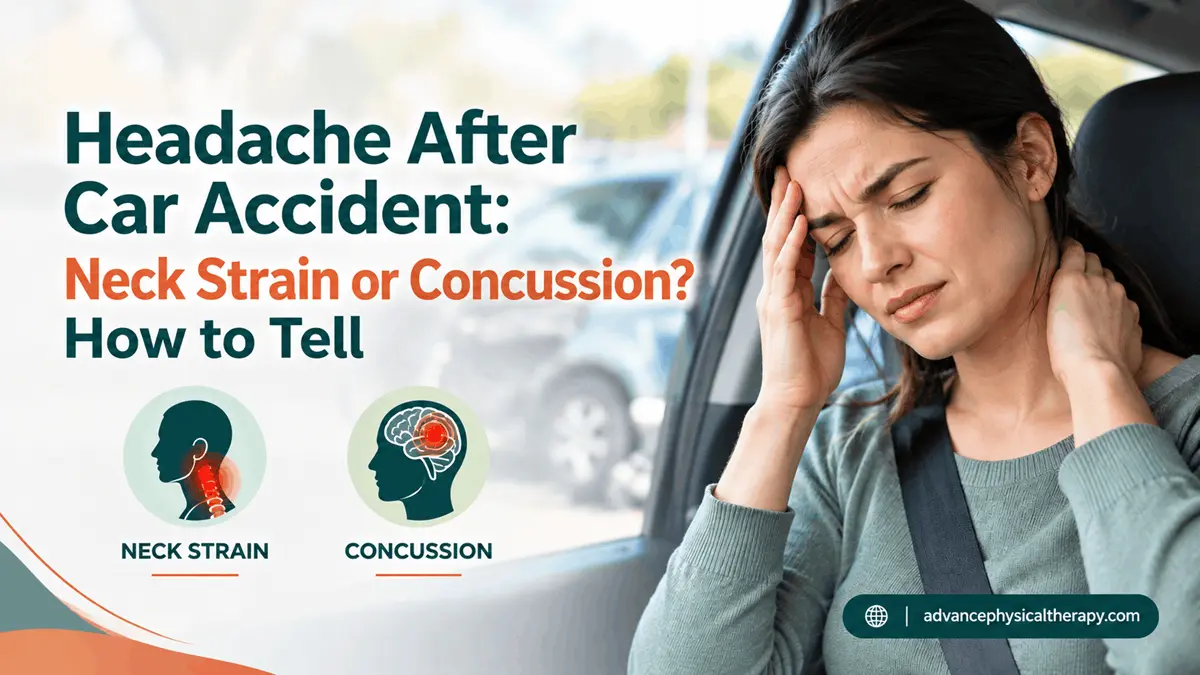
The crash was two days ago. You felt fine at the scene, maybe a little shaken. Now there’s a headache that won’t settle. So you’re typing headache after car accident into your phone, trying to work out whether this is normal.
Usually it’s one of two things: a neck that took the hit, or a brain that got jolted. Sometimes it’s both. The difference matters. A neck-driven headache needs hands-on neck work; a concussion headache needs a careful, graded plan. Treat the wrong one and the headache sticks around.
A headache after a car accident most often comes from a strained neck (cervicogenic headache), a concussion, or an irritated occipital nerve at the base of the skull. Neck headaches change when you move your head; concussion headaches worsen with screens, noise and mental effort. A worsening headache, repeated vomiting or confusion needs emergency care first.
Timing is a clue too. The International Classification of Headache Disorders (ICHD-3) ties a headache to whiplash when it starts within 7 days of the injury. It calls that headache persistent once it lasts past 3 months. Neck and concussion symptoms often overlap, so a hands-on evaluation beats guessing.
Why Car Crashes Cause Headaches Even Without a Head Impact
You don’t have to hit your head to get a headache after a crash, because the force travels up through the neck. In a rear-end or side impact, the seatbelt holds your torso while your head keeps moving, then snaps back. That strains the small joints, ligaments and muscles at the top of the neck.
The top three neck joints, C1 to C3, share nerve pathways with the head. Pain starting there is felt at the back of the skull, the temple or behind one eye. That’s a cervicogenic headache.
The same whipping motion can shift the brain inside the skull. That’s how a concussion happens with no bump or bruise. Headache after whiplash is common, too. A 2023 review in Musculoskeletal Science and Practice reported it in about 6 in 10 people during the first week.
Where It Hurts: Matching a Headache After a Car Accident to Its Source
Where the pain sits, how it feels and what makes it worse usually point to one of four sources. It’s a starting map, not a diagnosis.
| Headache type | Where you feel it | What it feels like | What makes it worse | Other clues |
|---|---|---|---|---|
| Cervicogenic (neck-driven) | Back of the head, often one side; can wrap to the temple or behind the eye | Dull, deep ache | Turning or tilting the head, long drives, desk work | Stiff neck, less rotation to one side, tender upper neck |
| Muscle tension | Band around the head, back of the skull, tops of the shoulders | Tight, pressing | End of the day, stress, a bad sleeping position | Knots in the upper trapezius, shoulders creeping up |
| Post-concussion | Whole head or forehead; a feeling of pressure | Pressure or throbbing | Screens, bright light, noise, reading, exercise | Brain fog, dizziness, nausea, poor sleep, irritability |
| Occipital neuralgia | Base of the skull, shooting up over one side of the scalp | Sharp, electric, zapping | Touching the scalp, brushing hair, lying on a pillow | Scalp tenderness, pain behind the eye on the same side |
In practice, real patients rarely fit one row. What typically shows up in the evaluation is a mix: a stiff upper neck plus concussion symptoms on top. That overlap is the main reason post-crash headaches drag on. One part gets treated; the other gets missed.
When a Headache After a Crash Needs the ER, Not Physical Therapy
Call 911 or go to the ER first if your headache comes with any of these signs:
- A headache that keeps getting worse and doesn’t go away
- Repeated vomiting or nausea
- Slurred speech, confusion, or unusual drowsiness
- Weakness, numbness or poor coordination in an arm or leg
- One pupil larger than the other
- Seizures, or losing consciousness at any point
- A sudden, explosive headache that feels like the worst of your life
The first six come from the CDC’s concussion danger signs. A sudden, explosive headache is a separate emergency warning that doctors treat as a possible bleed. Older adults and anyone on blood thinners should get checked promptly, even for a milder headache. Bleeding risk after head trauma runs higher in both groups. Physical therapy is the right next step once a doctor has ruled these out.
How a Physical Therapist Tells Neck and Concussion Headaches Apart
A physical therapist separates the two by testing the neck directly, then screening the systems a concussion disturbs. Three parts of the exam do most of the work.
Upper-Neck Joint Testing
The cervical flexion-rotation test is a standard check. The therapist bends your neck fully forward, then turns your head to each side. A clear loss of rotation on one side points to the C1–C2 level, especially if it brings on your usual headache.
Muscle and Nerve Palpation
Next, the therapist presses along the upper trapezius, the suboccipital muscles and the greater occipital nerve. If one spot reproduces the headache or zaps the scalp, the source narrows fast.
Eye, Balance and Exertion Screening
Quick eye-tracking, focusing and balance tests follow, plus a symptom check as your heart rate rises. Headaches that flare here, not with neck movement, lean toward concussion. Your physician confirms that diagnosis, and your therapist coordinates with them.
No single test settles it, and that’s an honest limitation. Stubborn occipital neuralgia or an injury-triggered migraine pattern may need a physician for medication or a nerve block alongside therapy.
What Treatment Looks Like for Each Type of Post-Accident Headache
Neck-driven headaches respond best to hands-on care and neck strengthening, while concussion headaches need a graded return to activity.
For cervicogenic and tension headaches, manual therapy comes first: upper-neck joint mobilization, soft-tissue release and gentle traction. Then come deep neck flexor training, shoulder-blade strengthening and changes to how you sit and drive. If a strained upper trapezius, known as trapezius myalgia, is the main culprit, soft-tissue work and posture retraining lead.
Post-concussion headaches call for a different approach. Concussion treatment typically uses light aerobic exercise below the symptom threshold, eye and balance drills, and paced screen time. Current guidance has moved away from long stretches of total rest.
One trap worth naming: when a headache lingers after whiplash, ICHD-3 flags medication-overuse headache as a possibility. Taking pain relievers most days can keep the cycle going, so tell your doctor how often you’re reaching for them.
Headaches are usually one piece of a bigger picture. A full auto accident injury treatment plan checks the neck, upper back, shoulders and balance together.
Frequently Asked Questions
Is it normal to have a headache after a car accident?
Yes. It’s one of the most common symptoms after a crash, even a low-speed one. Most come from neck strain or muscle tension and ease within days to a few weeks with the right care. The one to get evaluated is a headache that’s still building after the first week instead of fading.
Can a headache start days or weeks after a car accident?
Yes. Neck-driven headaches often show up once stiffness sets in over the following days. Concussion headaches can surface later, when you go back to work, screens or exercise. A headache that starts weeks later can still be crash-related. A new cause should be ruled out too, so get it checked.
Can a car accident trigger migraines?
It can. A head or neck injury can set off migraine-type headaches in people who never had them. Expect throbbing pain, light and sound sensitivity, and nausea. It can also make existing migraines more frequent. Migraine management usually needs a physician; physical therapy helps when neck stiffness is feeding the attacks.
How long do headaches last after a car accident?
It depends on the source. Muscle-tension and mild neck headaches often settle within a few weeks with the right care. Mixed neck-and-concussion headaches tend to take longest, especially when only one part gets treated. With a plan that’s working, you should notice fewer or milder headaches within the first few weeks.
Does PIP cover physical therapy for headaches after a crash in Texas?
If your Texas auto policy includes Personal Injury Protection (PIP), it pays medical costs, including physical therapy, regardless of fault. It pays up to your policy limit. If PIP runs out or is disputed, Advance Physical Therapy also works with an attorney’s Letter of Protection. Coverage depends on your policy.
Still Getting Headaches Since the Crash? Get the Source Checked
A headache after a car accident that’s still around a week or two later rarely clears up by waiting. At Advance Physical Therapy, a licensed physical therapist performs the evaluation. They test your neck, screen for concussion signs and build a customized plan around what’s behind your headache.
No referral is needed to start in Texas. We work with PIP and attorney Letters of Protection, so paperwork doesn’t hold up your care. We’ve treated Texans since 1999, with eight clinics across the Houston, Dallas and Bryan–College Station areas. Book an evaluation at the clinic closest to you.