
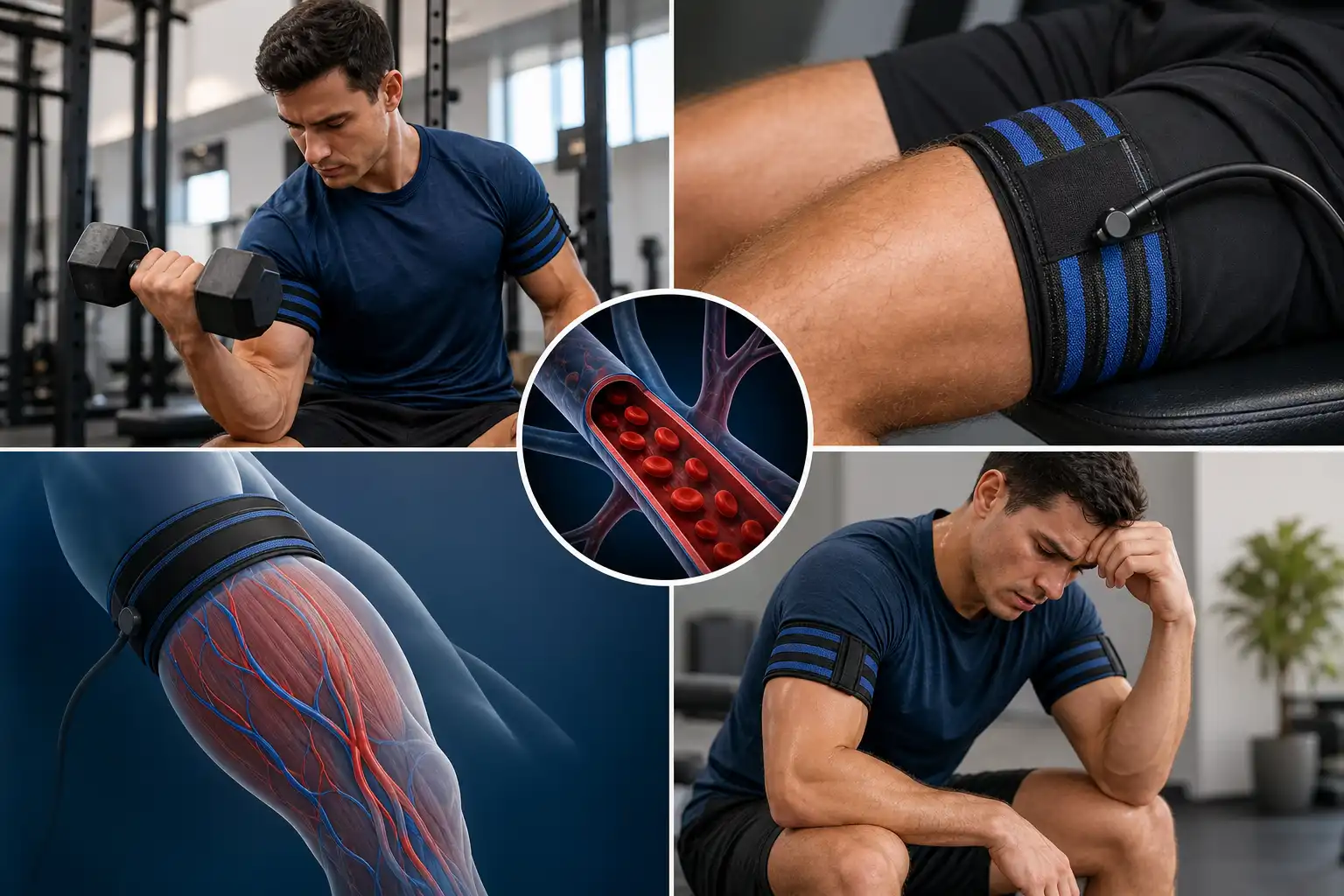
Your surgeon says the knee is healing well. Your thigh, though, looks half the size it used to, and a normal leg press still feels like a bad idea. That gap between “healed” and “strong” is where a lot of rehab stalls. Blood flow restriction training is one of the ways physical therapists close it. A cuff around the upper arm or thigh lets light weights do the work that usually takes heavy ones. It sounds strange, and the first set feels strange too. Here’s how it works, what each set really feels like, and what the research says it can and can’t do.
Blood flow restriction training (BFR training) is a strengthening method where an inflatable cuff on the upper arm or thigh partially limits blood flow into a muscle and blocks most blood from leaving it. Combined with light loads, typically 20–40% of your one-rep max, it can build strength and muscle size without heavy lifting.
That makes it useful when heavy weights aren’t an option: after surgery, with a painful joint, or during a long injury layoff. It isn’t magic, though. Heavy lifting still builds more maximum strength, and the method only makes sense once a clinician has ruled out clotting and circulation risks.
How Does Blood Flow Restriction Training Work?
Blood flow restriction training works by trapping blood and metabolic byproducts inside a working muscle, so a light set sends the same “this is hard” signal as a heavy one. A cuff at the top of the limb slows arterial blood coming in and blocks most venous blood going out.
During the set, the muscle runs low on oxygen and fills with lactate and hydrogen ions, byproducts that normally build up only with heavy lifting or sprinting. Your body responds by recruiting fast-twitch fibers, the ones usually saved for maximal efforts. When the cuff deflates, fresh blood flushes through.
BFR isn’t limited to lifting weights. The research describes three ways to apply it:
- With resistance exercise. Light weights or bands, the most common and best-studied use.
- With low-intensity aerobic exercise. Slow walking or easy cycling with the cuffs on.
- Passively, without exercise. The cuff inflates and deflates while you rest, used to slow muscle loss when a limb can’t move much yet.
What Blood Flow Restriction Training Actually Feels Like
Blood flow restriction training feels like a hard set squeezed into a few minutes: a firm grip from the cuff, a burn that arrives much sooner than the weight suggests, then quick relief once the pressure drops. The sensations follow a fairly predictable pattern from set to set.
The first set usually starts easy. A common protocol opens with 30 reps, and the first 15 or so feel almost like nothing. Then the burn builds fast. By the second and third sets, the muscle feels heavy and tight. Many people can’t finish the last 15 reps of the fourth set. That’s the point, not a failure.
The limb below the cuff often turns pink or blotchy as blood pools in the small vessels. Some people notice a dull ache or mild pins and needles under the cuff. Once the cuff comes off, a rush of warmth spreads through the muscle, and the limb looks pumped for a while afterward. Next-day soreness is common in the first week or two.
It isn’t comfortable. In one study summarized in a 2025 Frontiers in Physiology review, peak pain during a light single-leg press ran about 6 to 8 out of 10. The common mistake is treating that burn as a cue to push harder. Numbness, sharp pain, or tingling that lingers after release means the session stops.
Does Blood Flow Restriction Training Work? What the Research Supports
Blood flow restriction training reliably builds muscle and strength with light loads, but heavy lifting still wins on maximum strength. A widely cited 2019 position stand on BFR exercise in Frontiers in Physiology summarizes a meta-analysis that found high-load training produced bigger strength gains, while gains in muscle size were comparable.
| Approach | Typical load | Muscle size gains | Maximum strength gains | Stress on the joint |
|---|---|---|---|---|
| Heavy lifting | About 60–85% of one-rep max | Strong | Strongest | Highest |
| Light lifting alone | About 20–40% of one-rep max | Smaller in most studies | Smaller | Low |
| Light lifting with BFR | About 20–40% of one-rep max | Comparable to heavy lifting | Good, but below heavy lifting | Low |
That trade-off is why BFR earns its place in rehab. Most physical therapy patients can’t lift heavy yet, so the fair comparison is BFR versus light exercise alone. There, adding BFR produced greater gains in size and strength in most studies the position stand reviewed.
Texas researchers are part of this work. A randomized trial run by UTHealth Houston tested BFR after arthroscopic knee surgery. Patients trained at 30% of one-rep max, with the thigh cuff at 80% of limb occlusion pressure.
In practice, BFR shows up most in post-operative rehabilitation, where a repaired knee or shoulder can’t take heavy load for weeks. It’s also common in rehab for sports injuries, where an athlete needs to hold onto muscle while the injured tissue heals.
BFR isn’t a fix for every problem, though. If pain comes from a stiff joint, an irritated nerve, or the way you move, a cuff won’t solve it. It works best inside a plan that also includes hands-on manual therapy and a gradual return to normal loading. Patients don’t all respond at the same pace, either.
Rehab BFR vs. Gym BFR: Same Idea, Different Rules
Rehab BFR and gym BFR use the same principle, but rehab BFR adds screening, measured pressure and supervision because the person using it is healing. In the gym, healthy lifters often use elastic BFR bands during lighter training weeks. The goal there is keeping muscle while giving the joints a break.
Bands are tightened by feel, and that’s where the two worlds split. Testing summarized in that 2025 Frontiers review found elastic straps gave far less consistent restriction than a personalized pneumatic tourniquet. For a healthy lifter, a loose or tight band mostly changes how well the set works. For someone a few weeks out of surgery, it changes the risk.
That’s why supervised blood flow restriction therapy starts with a health screening and a measured limb occlusion pressure, the point where blood flow below the cuff fully stops. At Advance Physical Therapy, our physical therapists check for clot history, circulation problems and blood pressure concerns before BFR becomes part of anyone’s plan.
Frequently Asked Questions
Where did blood flow restriction training come from?
BFR started in Japan, where Yoshiaki Sato developed it in the 1960s as “kaatsu,” meaning training with added pressure. The personalized, pressure-measured version came later. Much of it was refined at Brooke Army Medical Center’s Center for the Intrepid in San Antonio. Physical therapists there used it to rebuild strength in wounded service members.
Does BFR training make muscles look bigger right away?
The swollen, pumped look right after a set is mostly fluid from blood pooling and cell swelling, and it settles once normal blood flow returns. Real muscle growth takes weeks of consistent training. That temporary swelling still matters, though, because it’s one of the signals that drives muscle growth.
Does BFR training work for the upper body?
Yes. Cuffs go on the upper arm for arm work. Muscles above the cuff, such as the shoulder and chest, can’t be restricted directly, but some research suggests they still benefit when trained alongside the restricted arm. That effect is still being studied, so results there are less certain.
Is BFR training the same as wearing compression sleeves?
No. Compression sleeves apply light, steady pressure meant to support circulation, and people often wear them for hours. BFR cuffs inflate much higher, set relative to your limb occlusion pressure, to block blood leaving the muscle during a set. They come off within minutes, between exercises.
Can’t Load the Muscle You Need to Rebuild? Start With an Evaluation
Blood flow restriction training isn’t a shortcut, and it isn’t right for everyone. For the right patient, it’s a measured way to rebuild muscle when heavy weights would set recovery back.
At Advance Physical Therapy, a licensed physical therapist performs the evaluation, screens you for clotting and circulation risks, and builds a customized plan. BFR goes in only if it fits. No referral is needed. Injured in a car accident? We accept PIP and work with attorney lien and LOP arrangements. We’ve served Texans for 26+ years across eight clinics in the Houston, Dallas and Bryan–College Station areas. Book an appointment at the physical therapy clinic closest to you.