
Introduction
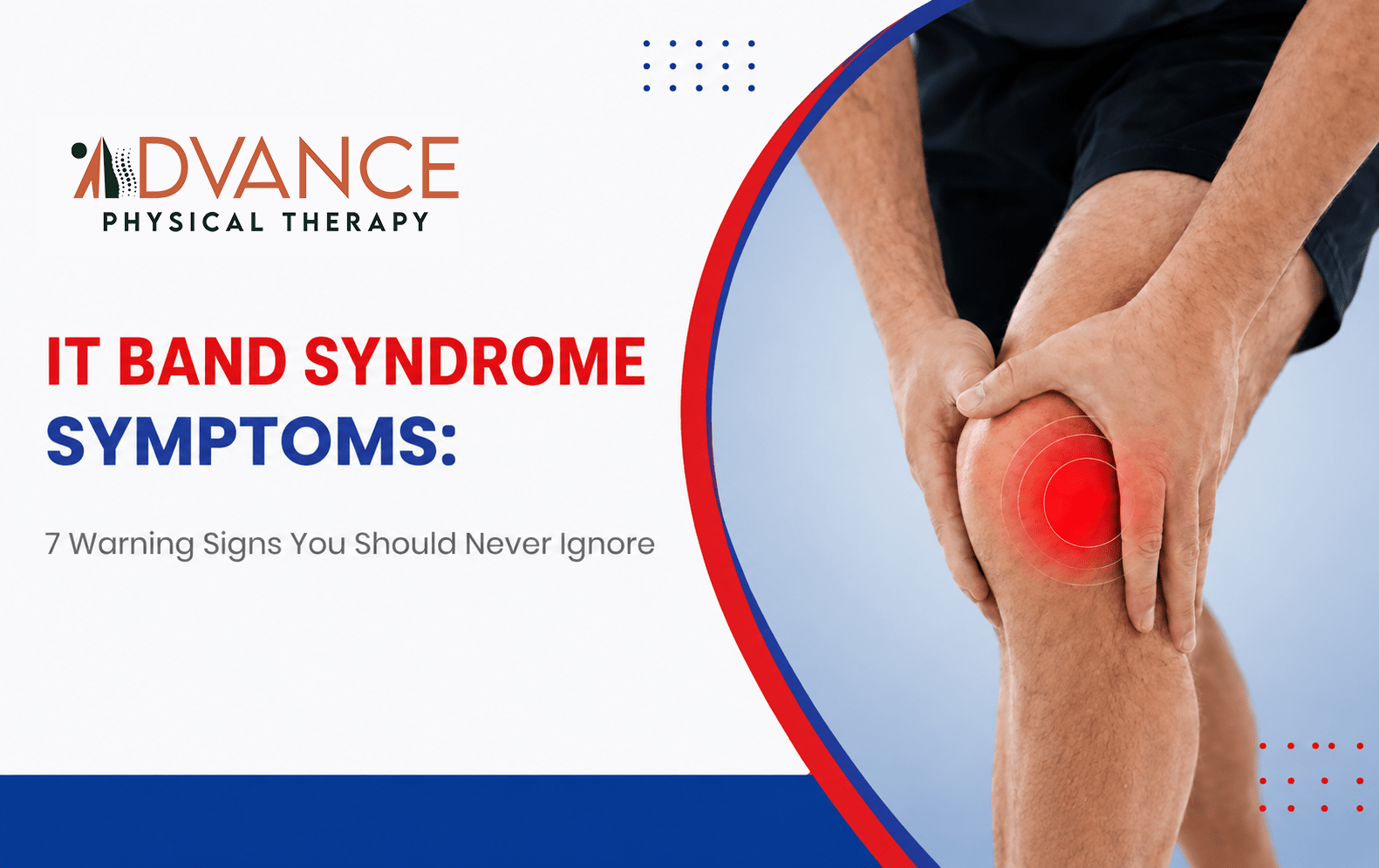
If you feel pain on the outside of your knee during walking, running, or climbing stairs, you may be dealing with Iliotibial Band Syndrome (IT Band Syndrome). It’s a common overuse injury that affects runners, cyclists, athletes, and even people with physically demanding jobs. The tricky part is that it usually starts small — a little twinge you can easily brush off — and slowly turns into pain that follows you every time you get active.
Ignoring those early symptoms can make the condition worse and lead to chronic pain or limited mobility. The good news: caught early, it responds really well to treatment. And at Advance Physical Therapy, you don’t need a referral to get started with outpatient physical therapy.
What Is IT Band Syndrome?
The iliotibial band (IT band) is a thick band of connective tissue that runs from your hip down to the outside of your knee. Its job is to stabilize the knee and support leg movement. When the IT band becomes tight or irritated, friction builds up near the knee joint, causing inflammation and pain. That’s what we call IT Band Syndrome.
Top 7 IT Band Syndrome Symptoms
1. Pain on the Outside of the Knee
This is the most common symptom. It usually starts as mild discomfort and gradually gets sharper during activity. Most people notice it while running, walking long distances, climbing stairs, or cycling.
2. Pain That Gets Worse During Exercise
IT band pain often builds with repetitive movement. You may feel fine at first, but the pain intensifies the longer you stay active — something runners and cyclists know all too well.
3. Tightness Around the Thigh or Hip
A tight feeling along the outer thigh or hip can signal IT band irritation. Tight hip muscles often add extra stress to the knee. Stretching alone may not fully fix it if muscle weakness or movement problems are involved.
4. Clicking or Snapping Sensation Near the Knee
Some people feel a snapping sensation when bending or straightening the knee. This happens when the tight IT band rubs against the outer knee. Left untreated, the inflammation tends to increase over time.
5. Tenderness When Touching the Knee
The outside of the knee may feel sore or sensitive to pressure. Even simple daily activities can start to feel uncomfortable as the irritation worsens.
6. Swelling or Inflammation
Swelling is usually mild, but inflammation around the outer knee can show up in more severe cases. It may also cause stiffness after exercise or after sitting for a long time.
7. Reduced Mobility or Weakness
As pain increases, many people start avoiding movement without even realizing it. That can lead to muscle weakness, poor balance, and reduced flexibility — and without proper treatment, the problem keeps coming back.
What Causes IT Band Syndrome?
It’s almost always an overuse problem rather than a single injury. Common contributors include:
• Overuse from running or cycling
• Poor running mechanics
• Weak hip muscles
• Tight muscles around the hip and thigh
• Sudden increases in activity level
• Improper footwear
Why rest alone often isn’t enough: If weak hips or poor movement mechanics caused the problem, the pain usually returns the moment you get active again — unless that underlying weakness is addressed.
How Is IT Band Syndrome Diagnosed?
A physical therapist or healthcare provider typically diagnoses IT band syndrome through a physical examination, movement assessment, pain-location evaluation, and flexibility testing. In some cases, imaging tests are recommended to rule out other knee conditions.
How Physical Therapy Helps IT Band Syndrome
Physical therapy treats both the pain and the underlying movement problems causing it. If your symptoms aren’t settling on their own, our therapists provide hands-on iliotibial band syndrome treatment built around your specific case — not a generic stretch sheet. A typical plan may include:
Treatment may include:
• Stretching exercises
• Hip and leg strengthening
• Manual therapy
• Movement correction
• Balance and mobility training
• Personalized recovery programs
Best Exercises and Stretches for IT Band Syndrome
- Standing IT Band Stretch
• Glute Strengthening Exercises
• Foam Rolling
• Hip Mobility ExercisesA licensed outpatient physical therapy provider can create a customized exercise plan based on your symptoms and activity level.
IT Band Syndrome Recovery Timeline
Recovery time depends on the severity of the condition and how early treatment begins.
• Mild cases: 2–4 weeks
• Moderate cases: 4–8 weeks
• Chronic cases: Several months
Consistent treatment, proper exercises, and activity modification usually improve recovery outcomes.
IT Band Syndrome: Questions Patients Ask Us Most
Do I need a doctor referral for physical therapy?
In most cases, no. Patients can start treatment directly without visiting another provider first. At Advance Physical Therapy, no referral is needed for most outpatient physical therapy services.
How long does IT band syndrome take to heal?
A mild case caught early often eases in a few weeks with the right activity changes and exercises. Chronic cases that have gone on for months can take six weeks or longer, and they respond best to a proper plan rather than rest alone. The biggest factor is whether you fix the underlying hip and glute weakness that started it.
Should I keep running with IT band pain?
No — running through it usually makes it worse and drags recovery out. That sharp outer-knee pain is friction building up, and every stride adds to it. Back off running for a while, swap in low-irritation activity if you need to stay active, and get the cause treated. Most runners come back faster by resting it early than by pushing through.
IT band vs meniscus — how do I tell the difference?
IT band pain sits on the outside of the knee, feels sharp or burning, shows up a set distance into activity, and eases with rest. Meniscus problems usually cause pain deeper inside the knee joint, often with clicking, locking, catching, or swelling, and sometimes start after a twist or injury rather than overuse. If your knee locks, gives way, or swells, get it assessed to rule out a meniscus issue.
What is the best treatment for IT band syndrome?
The best treatment fixes why it started, not just the symptoms. That means easing off the aggravating activity for a while, hands-on manual therapy to calm the irritated tissue, and a strengthening program for the hips, glutes, and core so the leg tracks properly. At Advance Physical Therapy, our therapists build a plan around your case instead of handing you a generic stretch sheet.
What does an inflamed IT band feel like?
It usually feels like sharp or burning pain on the outside of the knee, often with tightness or an achy, rubbing sensation along the outer thigh. Some people notice a snapping or catching feeling when the knee bends. It tends to get worse the longer you stay active and eases once you stop.
What is the best position to sleep with IT band syndrome?
Sleeping on your back or on the non-painful side is usually most comfortable. If you’re a side sleeper and the sore leg is on top, put a pillow between your knees to stop the leg from dropping inward and pulling on the IT band. Avoid lying directly on the painful side, since that adds pressure to the irritated outer knee and hip.
Is walking bad for IT band syndrome? Flat, easy walking is usually fine, but downhill walking, stairs, and long distances tend to irritate the IT band. If walking makes the outer-knee pain worse, shorten the distance and avoid slopes until it calms down.
See a therapist sooner if the pain is severe, your knee is swelling, it’s not improving after a couple of weeks of backing off, or it’s stopping you from walking normally.
Find IT Band Syndrome Treatment Near You
Advance Physical Therapy has clinics across Texas, so you can get hands-on care close to home — no referral needed: Irving, Duncanville, College Station, Cypress, Richmond, Sugar Land, East Houston, and Baytown.
Book a Physical Therapy Evaluation
Dealing with knee pain that won’t quit? Our physical therapists will pinpoint what’s driving your IT band pain and build a plan to get you back to running and walking pain-free. No referral required. Call (281) 984-4348 to schedule your evaluation.
Also Read: Iliotibial Band Syndrome (ITBS): A Common Overuse Injury