
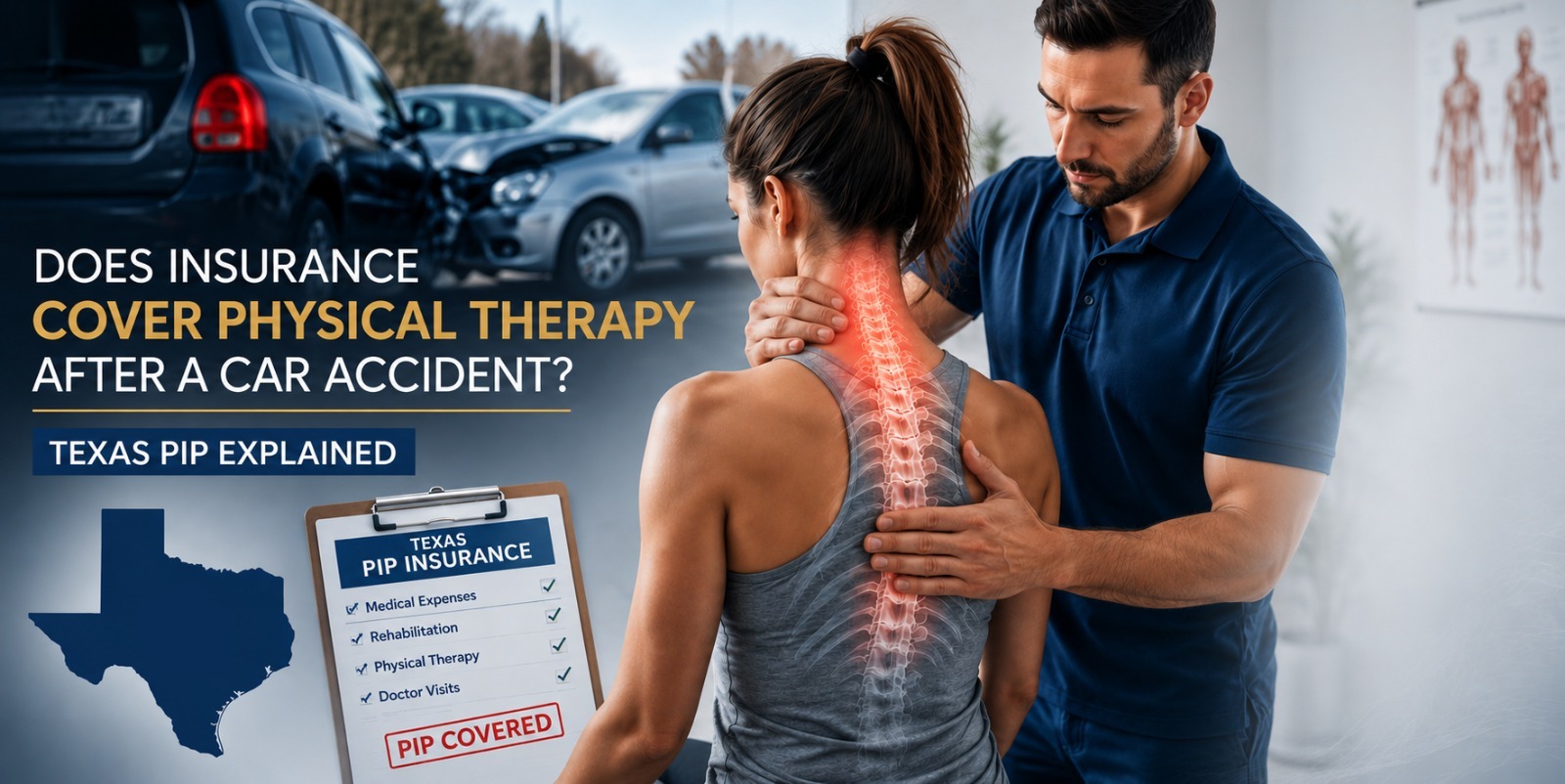
You are hurting after a wreck, and somewhere between the sore neck and the missed work, one question keeps circling: who is going to pay for all this? It is usually the first thing people ask when they call us. The short answer is that yes, insurance usually does cover physical therapy after a car accident in Texas — but which policy pays, and how fast, depends on your coverage and who was at fault. Here is how it actually works, from the clinic side.
Yes. In Texas, physical therapy after a car accident is typically covered by Personal Injury Protection (PIP) on your auto policy, which pays regardless of who caused the crash. If another driver was at fault, their liability insurance may pay. MedPay and your health insurance can also apply, depending on your policy.
What trips people up is the order. PIP and MedPay pay quickly and no-fault, so they usually cover treatment while it is happening. An at-fault liability claim often settles months later, after care is done. Knowing which source to use first is the difference between starting therapy this week and waiting on a claim — and it is the part a clinic that handles these cases every day can sort out for you.
How PIP insurance works in Texas
Personal Injury Protection (PIP) is no-fault auto coverage that pays your accident-related medical bills — including physical therapy — regardless of who caused the crash.
Here is the part most Texans do not realize: insurers are required to offer PIP with every auto policy, and it is added automatically unless you rejected it in writing when you signed up. So even if you never remember choosing it, there is a good chance it is on your policy. That matters, because PIP does three things that are genuinely useful after a wreck.
It pays no-fault, so you do not have to prove the other driver was responsible before treatment gets covered. It pays quickly, because there is no fault to argue over first. And it covers more than just medical bills — PIP can also go toward a portion of lost wages if your injuries keep you off work. The Texas Department of Insurance notes that PIP benefits are paid without regard to fault, which is exactly why it is the fastest way to get care started.
Your specific limit depends on the coverage you chose, so we confirm it before treatment rather than guessing. Even a smaller amount of PIP goes a long way when therapy starts early and keeps a soft-tissue injury from turning chronic.
PIP vs. MedPay vs. health insurance vs. at-fault claims
After a Texas crash you often have four possible ways to pay for physical therapy — PIP, MedPay, your health insurance, and the at-fault driver’s liability insurance — and they are used in a specific order.
Most people assume they have to pick one. You do not. In many Texas cases these layers stack, and using them in the right sequence is what lets you get treated now instead of waiting on a settlement. Here is how they compare.
| Coverage source | Who it pays for | How fast | Depends on fault? |
|---|---|---|---|
| PIP (your auto policy) | You and your passengers | Fast — first line | No — pays regardless of fault |
| MedPay (optional add-on) | You and your passengers | Fast | No — pays regardless of fault |
| Health insurance | You | Ongoing, with deductible/copay | No |
| At-fault driver’s liability | You, if they caused it | Slow — often after treatment ends | Yes — fault must be established |
PIP and MedPay are the quick, no-fault options, so they usually carry your treatment while it is happening. Health insurance can run alongside them and even pick up copays. The at-fault driver’s liability coverage may ultimately be responsible if someone else caused the crash — but that claim tends to settle after treatment is finished, which is why it rarely pays your bills as you go.
What PIP typically covers for physical therapy
PIP typically covers your physical therapy evaluation and treatment sessions, related medical care from the crash, and a share of lost income — up to your policy limit.
In practice, what we see PIP applied to includes your initial evaluation and ongoing therapy visits, the first medical exam after the crash, and the reasonable, necessary care tied directly to your accident injuries. Because PIP is no-fault and does not require a referral, it fits neatly with how physical therapy already works in Texas — you have direct access, so you can start your auto accident injury treatment without waiting on a doctor’s note.
One honest limitation: PIP has a ceiling, and a serious injury can reach it. That is not a reason to skip care — it is a reason to start early, use the coverage deliberately, and let someone who does this daily help you sequence it. You can also review the full list of insurance plans we accept before your first visit. When PIP runs low, that is often the point where health insurance or, if an attorney is involved, a Letter of Protection comes into the picture.
How we coordinate with your claim and attorney
We verify your coverage, bill the correct source in the right order, and provide the treatment documentation your claim or attorney needs — so you are not managing the paperwork while you heal.
This is the part patients are most relieved about, and it is also where the law-firm articles go quiet, because it is clinic work, not legal work. Here is what it looks like in practice. Before your first visit, we confirm what PIP, MedPay, or other coverage you have and tell you what to expect. We bill the right policy first and keep the documentation organized. If you are represented, we coordinate directly with your attorney’s office, and the detailed, consistent treatment records we produce also strengthen your claim — settlement value leans heavily on documented care. You came in for your neck pain that showed up after the crash or back pain from the same wreck, not to argue with an insurance adjuster, and we keep it that way.
What to bring to your first visit
Bring your auto insurance information, your health insurance card, any accident or police report, a photo ID, and your attorney’s contact details if you have one.
A little preparation gets your coverage sorted faster, but do not let a missing document stop you from being seen. Here is the short list:
- Your auto insurance information (yours, and the other driver’s if you have it)
- Your health insurance card
- The accident or police report, if one was filed
- A photo ID
- Your attorney’s contact information, if you are working with one
- Any medical records or imaging from the ER or a doctor you have already seen
If you are missing something, we work with what you have and help track down the rest. The one thing not to do is wait. Soft-tissue injuries respond best when therapy starts early — the paperwork can catch up. Many of the same patients also have whiplash from the same crash, which follows its own recovery timeline.
Frequently Asked Questions
Does PIP cover physical therapy in Texas?
Yes. Texas PIP is no-fault, so it covers physical therapy after a car accident regardless of who caused it, along with related medical care and a portion of lost wages. It is included on your auto policy automatically unless you rejected it in writing, so many drivers have it without realizing. Confirm your limit with your insurer.
Who pays for physical therapy after a car accident?
It depends on your coverage and fault. Your own PIP or MedPay pays quickly whether at-fault or no-fault, so it usually covers treatment as it happens.
Health insurance will not cover injuries resulting from the accident.
If another driver was at fault, their liability insurance may pay — but that claim often settles after treatment ends, not during.
Do I need to use my own insurance after a crash?
Often yes, at least first. PIP and MedPay pay while your care is ongoing, rather than waiting for a fault claim to settle later. Using your PIP does not mean you were at fault, and it generally does not raise your rates the way an at-fault accident might. The at-fault driver’s insurer may reimburse costs afterward.
What is MedPay, and is it different from PIP?
MedPay is optional medical-payments coverage on your auto policy. Like PIP, it is no-fault and pays medical bills regardless of who caused the crash, but it does not cover lost wages the way PIP does. Some Texas drivers carry both. Either one can help pay for physical therapy after an accident.
What happens if my PIP runs out during treatment?
If PIP reaches its limit before you finish care, treatment does not have to stop. Health insurance can take over, and if you are working with an attorney, a Letter of Protection lets us continue treating you and get paid from your settlement later. We help you plan for this so there is no gap in care.
Do I need a referral for physical therapy after a car accident?
No. Texas has direct access to physical therapy, so you can start treatment without a doctor’s referral. This matters after a crash because it lets you begin care in the first days, when early treatment has the best chance of preventing a soft-tissue injury from becoming a long-term problem.
We Handle the Insurance Paperwork — You Focus on Getting Better
Been in a wreck and unsure who pays? That is exactly the part we take off your plate. As a physical therapy provider that has treated auto-accident injuries across Texas for 26+ years, Advance Physical Therapy verifies your PIP or MedPay coverage up front, bills the right source, and coordinates with your attorney when there is one — no referral needed to start. We handle the insurance paperwork; call your nearest location to get started, and if a claim is disputed or delayed, ask us about treating now under a Letter of Protection.