

Does Insurance Cover PT After a Car Accident? Texas PIP Guide
If you’ve been in a wreck and you’re hurting, the last thing you want to untangle is who’s going to pay for your treatment. It’s one of the first questions people ask when they call us: “Does insurance actually cover physical therapy after a car accident?” The short answer is usually yes — but how it gets paid depends on your policy, who was at fault, and the type of coverage you carry. This guide breaks it down in plain English, with a focus on how it works here in Texas. The good news up front: in Texas, most people have more coverage available than they realize, and our team handles the paperwork side so you don’t have to figure it out alone. 🛡️How PIP insurance works in Texas PIP stands for Personal Injury Protection, and it’s one of the most useful types of coverage after a car accident. Here’s the part most Texans don’t know: in Texas, insurers are required to offer PIP with every auto policy, and it’s included automatically unless you signed a form specifically rejecting it in writing. So even if you don’t remember choosing it, there’s a good chance you have it. What makes PIP so helpful after a crash: It’s “no-fault.” PIP pays regardless of who caused the accident — no waiting to prove fault. It pays quickly. With no fault to sort out first, PIP can start covering your care right away. It covers more than medical bills. PIP typically goes toward physical therapy and can help with a portion of lost wages if injuries keep you from working. Your limit depends on your policy. Every plan is different, so your PIP amount is based on the coverage you chose. Even a modest amount can go a long way toward physical therapy — especially when treatment starts early. Ask us to help confirm your limits. ⚖️PIP vs. health insurance vs. at-fault claims There’s usually more than one way to get your physical therapy paid for after a crash. Understanding the difference helps you use them in the right order. 🟢 PIP Your own auto policy. Pays fast, no matter who was at fault. Often the first source people use. 🔵 Health insurance Covers PT too, with your usual deductibles and copays. Can work alongside PIP. 🟠 At-fault claim The other driver’s insurer may pay — but usually only after your treatment settles. The key takeaway: you don’t have to pick just one. In many Texas cases, these layers stack, and the goal is simply to make sure you can get treated now without a bill stopping you. 🩺What PIP typically covers for physical therapy When it comes to car accident PT coverage, PIP is often one of the most straightforward sources. While every policy is different and you should always confirm your specific limits, PIP commonly goes toward: Your physical therapy evaluation and treatment sessions Related care like the initial medical exam after the crash A portion of lost income if your injuries keep you off work Reasonable and necessary expenses tied to your accident injuries Because PIP is no-fault and doesn’t require a referral, it pairs perfectly with the way physical therapy works in Texas — where you can start treatment directly, without waiting on a doctor’s note. That lets you begin recovery fast, which is often the single biggest factor in how well and how quickly you heal. 🤝How we coordinate with your claim and attorney Here’s where a lot of the stress disappears. You don’t have to become an insurance expert to get treated. Our team deals with auto-accident cases every single day and handles the coordination behind the scenes. We verify your coverage and explain what to expect before or during your first visit. We handle the billing and paperwork — billing the right source in the right order. We work with your attorney, providing the records and documentation your case needs. We keep you informed, so there are no surprises about what’s covered. This is the part people are most relieved about. You came in for your neck or back — not to fight with an insurance company. We take that weight off your shoulders. 📋What to bring to your first visit A little preparation makes your first appointment smooth and helps us get your coverage sorted quickly. If you have them handy, bring: Your auto insurance information (yours, and the other driver’s if you have it) Your health insurance card The accident or police report, if one was filed A photo ID Your attorney’s contact information, if you’re working with one Any medical records or imaging from the ER or a doctor you’ve seen Don’t worry if you’re missing something — we can work with what you have. The most important thing is not to put off care while you gather paperwork. Soft-tissue injuries respond best when treatment starts early, so the sooner you’re seen, the better your recovery tends to go. 🚗Get treated now — we’ll sort out the coverage Money worries stop a lot of people from getting the care they need after an accident, and that delay often makes injuries harder to treat later. You don’t have to let that happen. Between PIP, health insurance, and at-fault claims, most Texans have a way to get physical therapy covered — and our team is here to help you use it. As a multi-location physical therapy clinic across Texas, we treat auto-accident injuries every day and handle the insurance coordination for you. If you’ve been in a wreck, we can also help with the full range of injuries that come with it, from whiplash and neck pain to back and shoulder problems. Been in a car accident? Don’t let insurance worries delay your recovery. We handle the paperwork so you can focus on healing — free injury screening, no referral needed, PIP accepted. 📞 Call (281) 984-4348 Dallas–Fort Worth Irving Duncanville Greater Houston Cypress East Houston Baytown Richmond Sugar Land Brazos Valley College Station /

Back Pain After a Car Accident: Why It Happens and How Physical Therapy Helps
You walked away from the crash feeling mostly okay. But a few hours later—or maybe the next morning—your lower back started hurting. By day three, you can barely bend down to pick something up. This is one of the most common scenarios we see in our clinics. Back pain after a car accident doesn’t always show up right away, and people are often surprised how much it impacts their daily life. The good news? It doesn’t mean you’re headed for surgery or a lifetime of painkillers. We’ve helped hundreds of people just like you recover without surgery using hands-on physical therapy.Let’s talk about why your back hurts after a crash, what’s actually injured, and what real recovery looks like. How Car Crashes Injure Your Spine and Lower Back When two cars collide, your body experiences forces it’s not designed to handle. Even a “minor” accident at 15 mph can create enough force to hurt you. Here’s what happens: The initial impact: Your torso gets jerked forward or backward suddenly, while your spine tries to stabilize. Your muscles contract hard to protect the spine, but this rapid movement can strain ligaments, muscles, and the small joints that connect your vertebrae. Whiplash isn’t just in your neck: Most people know about whiplash injuries to the neck, but the same mechanism injures your lower back. The sudden force travels through your entire spine, and your lumbar spine (lower back) absorbs a lot of that stress, especially if you were sitting upright or were hit from behind. Inflammation takes time: Injuries to soft tissue—your muscles, tendons, and ligaments—don’t always hurt immediately. You might feel fine the first day because of adrenaline and natural numbing from stress. By day two or three, inflammation builds up, and that’s when the real pain hits. In some cases, the crash also damages the discs between your vertebrae or irritates the nerves in your lower back. That’s a different story, and we’ll cover that next. Soft-Tissue Strain vs. Disc Injury—How to Tell Not all lower back pain after a car accident is the same. Here’s how to recognize what you might be dealing with: Soft-tissue strain (muscle and ligament injuries): Pain that feels muscular or achy, usually worse when you move Stiffness that improves slightly with rest but comes back after sitting too long Localized pain (usually just one area, like your lower left back) Pain that’s worse in the morning or after activity No numbness, tingling, or weakness in your legs Disc injury or nerve irritation: Sharp, shooting pain that radiates into your buttocks or down one leg Numbness, tingling, or weakness in your legs or feet Pain that gets worse when you bend forward or sit Difficulty controlling your bladder or bowel (rare—call a doctor immediately if this happens) The thing is, most people have a combination of both. You might have strained muscles and a minor disc issue. The good news? Physical therapy addresses both, and it works even better when you start early. The longer you wait, the more your body adapts to pain by moving differently, and that creates new problems. Why Early Treatment Helps You Avoid Surgery Here’s what we tell people: surgery should be the last option, not the first. Most lower back pain—even after an accident—heals with the right physical therapy approach. You don’t need surgery if you’re willing to put in the work with PT. Why wait and see isn’t a good strategy: If you ignore back pain and hope it goes away, your body compensates. You start moving differently to avoid pain. You avoid bending or twisting. Your core muscles weaken. You spend more time sitting, which makes discs unhappy. Six months later, you’re worse than you were, and your insurance company tells you that surgery might be your only option. Why early PT matters: When you start physical therapy within the first few weeks after an accident, your therapist can identify exactly what’s injured and prevent that cascade of compensation injuries. Early treatment means: Reducing inflammation faster through hands-on therapy and guided movement Rebuilding strength in your core and stabilizer muscles before they atrophy Restoring normal movement patterns so your body doesn’t develop new pain Addressing disc injuries with targeted movements that help the disc heel and take pressure off nerves Patients who start PT early typically recover in weeks, not months. And they stay recovered—no surgery, no chronic pain. Our Manual Therapy and Movement-Based Approach At Advance Physical Therapy, we don’t just tell you to do exercises at home and hope for the best. Our therapists use hands-on manual therapy to decrease pain and improve movement, then build your strength so the injury doesn’t come back. Here’s what your treatment might include: Hands-on manual therapy: Your therapist mobilizes stiff joints, releases tight muscles, and uses techniques like soft-tissue massage to decrease swelling. This isn’t generic massage—it’s targeted work to restore the function of your spine. Movement and exercise: Once we reduce pain and regain some mobility, we teach you specific movements to stabilize your core and restore proper movement patterns. This prevents re-injury. Patient education: We show you how to sit, sleep, bend, and move in ways that don’t aggravate your injury. Small changes to how you move throughout the day make a huge difference. Most importantly: you can see us without a doctor’s referral. You don’t need to wait for an appointment with your insurance company’s chosen provider. In Texas, you have direct access to PT, and your auto accident coverage or PIP insurance will typically cover it. What Real Recovery Looks Like Recovery isn’t the same for everyone, but here’s what we typically see: Weeks 1–2: Pain starts decreasing with manual therapy. You can move a bit more, but progress is slow. You’re still tender and tight. Weeks 3–6: This is where real progress happens. Your therapist starts adding more challenging exercises. You notice you can do things you couldn’t before—bend down, get out of the car without pain, sit through a meeting without

Shoulder Pain After a Car Accident: Causes and Recovery
Shoulder pain has a way of sneaking up on you after a car accident. You walk away from the crash thinking your shoulder is fine, and then a couple of days later you can’t reach for a coffee mug or fasten your seatbelt without wincing. We see this pattern constantly at our Texas clinics — the shoulder takes a real beating in a wreck, often more than people realize at the scene. This guide explains why your shoulder hurts after a crash, how to tell the difference between a simple strain and something that needs more attention, the warning signs that your pain won’t resolve on its own, and how hands-on physical therapy gets the shoulder moving again. And since this is Texas, you can come straight to a physical therapist — no referral needed. How seatbelts and bracing cause shoulder injuries Two things happen to your shoulder in a collision, and both can leave you sore for weeks. First, there’s the seatbelt. The shoulder belt runs diagonally across your chest and over one shoulder — and in a crash, that belt locks hard to hold you in place. It’s doing its job and protecting you from far worse, but that sudden force concentrated on one shoulder can bruise the soft tissue, strain the muscles, and irritate the joint. A seatbelt shoulder injury usually shows up as tenderness right along the path of the belt. Second, there’s bracing. In the split second before impact, most people instinctively grab the steering wheel and stiffen their arms. When the crash hits, that braced arm transfers a huge jolt straight up into the shoulder. This is one of the most common ways the rotator cuff gets injured in a car accident — the force travels through a locked, tensed arm and strains the muscles and tendons that stabilize the joint. Side and rear impacts add their own twist, sometimes literally — the shoulder can get wrenched in a direction it wasn’t ready for. The result is the same: pain, stiffness, and a shoulder that doesn’t want to move the way it used to. Rotator cuff vs. labral vs. soft-tissue strain Not all shoulder pain is the same. Here’s what we typically see after a crash, from most common to least: Soft-tissue strain and bruising. The muscles and tissue around the shoulder get overstretched or bruised by the seatbelt or the impact. It’s painful and stiff, but the structure is intact — and this type usually responds well to therapy. Rotator cuff injury. The rotator cuff is a group of muscles and tendons that keep your shoulder stable and let you lift and rotate your arm. A car accident rotator cuff strain or tear often shows up as pain when reaching overhead, weakness when lifting, or an ache that’s worse at night and makes sleeping on that side miserable. Labral injury. The labrum is a ring of cartilage that helps hold the ball of your shoulder in its socket. A hard jolt can tear it, causing a catching or clicking sensation, a feeling that the shoulder might “give out,” and deep pain with certain movements. Joint and AC injuries. The acromioclavicular (AC) joint at the top of the shoulder can get sprained, leaving a tender, sometimes swollen spot right on top of the shoulder. You don’t need to diagnose yourself — that’s our job during the evaluation. But knowing these exist helps you understand why “just resting it” doesn’t always work. A rotator cuff or labral injury left alone can quietly get worse. Signs your shoulder pain isn’t going away on its own Plenty of minor shoulder soreness fades within a week or two. But some signs tell you it’s time to get it looked at rather than wait it out. Consider seeing a physical therapist if you have: Pain that’s lasted more than a week or two without improving Weakness when lifting your arm, or trouble raising it overhead at all Pain that wakes you up at night or stops you sleeping on that side A catching, clicking, or grinding feeling when you move the shoulder Stiffness that’s slowly getting worse instead of better A feeling that the shoulder is unstable or might “pop out” And a quick safety note: if you have numbness or tingling running down your arm, sudden severe weakness, or shoulder pain along with chest pain and trouble breathing, treat that as an emergency and get medical care right away — those can point to a nerve injury or something beyond the shoulder itself. For ordinary post-crash shoulder pain and stiffness, physical therapy is exactly the right place to start. The hands-on PT approach to shoulder recovery The goal of PT after a shoulder injury is straightforward: calm the pain, restore the range of motion the crash took away, and rebuild the strength and stability that keep the shoulder healthy — ideally without surgery or long-term pain medication. Here’s what a typical plan looks like at our clinics. A thorough hands-on evaluation first. Your therapist checks how far the shoulder moves, which positions trigger pain, your strength, and whether the rotator cuff or joint is involved. This tells us what’s actually driving the pain instead of just where you feel it. Hands-on manual therapy. This is where a lot of early relief comes from. Skilled, gentle manual therapy techniques ease muscle guarding, free up the stiff joint, and reduce the tension pulling on the shoulder. For seatbelt strains and joint irritation, this often takes the edge off within the first few visits. Restoring movement. Guided, progressive stretching brings back the range of motion you’ve lost, so reaching, dressing, and driving stop being a struggle. Rebuilding strength and stability. As the pain settles, we add targeted exercises for the rotator cuff and the muscles around the shoulder blade. This is the step that actually prevents the injury from lingering or coming back — and it’s the part people who tough it out on their own almost always skip. Because

Neck Pain After a Car Accident: Recovery Guide | Advance PT
Neck pain is the single most common complaint we hear after a car accident. Someone gets rear-ended at a red light, walks away feeling shaken but okay, and then wakes up the next morning barely able to turn their head. If that sounds like you, you’re in the right place. This guide covers what causes neck pain after a crash, the warning signs that need a doctor right away, how long recovery usually takes, and what treatment actually looks like — all from a clinic that treats these injuries every single week across Texas. The most important thing to know up front: neck pain after a wreck is common, it’s treatable, and starting care early makes a real difference. And in Texas, you can come straight to a physical therapist — no referral needed. What causes neck pain after a car accident? When a car gets hit, your body absorbs a sudden, violent change in speed. Your seatbelt holds your torso in place, but your head — which weighs about as much as a bowling ball — gets whipped forward and back before the muscles can react. That rapid motion is where most neck injuries come from. Here’s what’s usually behind the pain: Whiplash. This is the big one. The sudden back-and-forth motion overstretches and strains the muscles, ligaments, and soft tissue in your neck. Whiplash neck pain is the reason so many people feel fine at the scene and stiff the next day. Muscle and ligament strain. The supporting tissues that hold your neck steady get overstretched, leaving you with a stiff neck after the accident, aching, and a limited range of motion. Joint irritation. The small facet joints in your cervical spine can get jarred and inflamed, causing sharp pain when you turn or tilt your head. Disc injury. In harder impacts, the cushioning discs between the vertebrae can bulge or herniate, sometimes pressing on a nerve. Nerve irritation. When a nerve in the neck gets compressed or inflamed, the pain can travel into the shoulder or arm, sometimes with tingling or numbness. A rear-end collision is the classic setup for whiplash, but neck pain shows up after side impacts and head-on crashes too. The speed of the crash doesn’t always match the severity of the injury, either — plenty of low-speed fender benders leave people with weeks of neck pain. Why neck pain is often delayed One of the most common questions we get is, “Why didn’t my neck hurt right after the crash?” The answer is adrenaline. In the moments after an accident, your body floods with stress hormones that mask pain and keep you functioning. Once that wears off — usually within a day or two — the real soreness sets in. This delay is completely normal and doesn’t mean your injury is worse. But it’s exactly why we tell people not to brush off a crash just because they “feel fine.” Soft-tissue injuries like whiplash often take 24 to 72 hours to fully show themselves. Red-flag symptoms: when to see a doctor right away Most neck pain after an accident is soft-tissue injury that heals well with the right care. But some symptoms point to something more serious involving the spine or nerves. Go to the emergency room or call 911 if you have any of these after a crash: Numbness, tingling, or weakness in your arms, hands, or legs Severe neck pain that doesn’t ease at all, or pain with a “shooting” electric quality Loss of bladder or bowel control Trouble walking, balancing, or coordinating your movements A severe headache that came on suddenly or keeps getting worse Confusion, slurred speech, vision changes, or loss of consciousness Pain that wraps around to your chest along with trouble breathing These can signal a spinal cord injury, a fracture, nerve damage, or a concussion — all things that need imaging and a physician’s evaluation first. When you’re in doubt, get checked at the ER. Physical therapy comes after you’ve been cleared of anything dangerous. What to do for neck pain after a car accident Once serious injury has been ruled out, here’s the practical path most of our patients follow to recover well: Don’t wait it out. The old advice of “rest and see if it goes away” often backfires. When you stop moving a stiff neck, the muscles tighten further and recovery drags on. Gentle, guided movement usually heals faster. Get evaluated early. A physical therapist can assess exactly which tissues are injured and start a plan before compensations and chronic stiffness set in. Manage the early pain sensibly. Ice in the first day or two and gentle movement within a comfortable range help calm things down. Your therapist will guide what’s safe. Keep moving within reason. Light, pain-free motion keeps blood flowing and prevents the stiffness that turns a short recovery into a long one. Document everything. If it was someone else’s fault, keep records of your symptoms and care. This matters for your insurance claim. Because we deal with auto-accident injuries constantly, we also handle the insurance side. If you’re working through a motor vehicle accident claim, we can coordinate with your PIP coverage and your attorney so you can focus on healing instead of paperwork. Neck pain and headaches after a car accident Headaches go hand in hand with whiplash, and they catch a lot of people off guard. When the muscles at the base of your skull and the upper part of your neck get strained, they can refer pain upward into the head — these are called cervicogenic headaches. They often feel like a dull, throbbing ache that starts at the back of the neck and spreads toward the forehead or behind the eyes. The good news is that when we treat the neck, these headaches usually settle down too. If your headaches are severe, come with vision changes, or follow a knock to the head, mention it — that combination can point to a concussion, which we

Chest Pain After a Car Accident: When It’s Serious and When It’s Not
If your chest hurts after a car accident, you’re not imagining it and you’re not overreacting. We see this all the time at our Texas clinics. A patient comes in a few days after a fender bender, rubbing the middle of their chest, saying “I feel fine, but this one spot is really sore.” Most of the time it’s a bruised chest wall from the seatbelt doing exactly what it’s supposed to do. Sometimes it’s something that needs a doctor right away. This guide walks you through both. We’ll cover why chest pain shows up after a crash, the warning signs that mean “go to the ER now,” the everyday causes that physical therapy can actually help with, and what recovery usually looks like. If you’re hurting and unsure, the safest move is always to get checked — and in Texas you can come straight to us, no referral needed. Why chest pain shows up after a crash In a collision, your body stops moving a lot faster than it wants to. Even at low speeds, the forces are real, and your chest takes a big share of them. Three things usually cause the soreness: The seatbelt. A seatbelt chest injury is one of the most common things we see. The belt locks across your chest and shoulder to keep you from hitting the dash or windshield. That same force can bruise the chest wall, strain the muscles between your ribs, or even crack a rib. The bruise often shows up a day or two later as a diagonal line of tenderness. The airbag. Airbags save lives, but they deploy fast and hard. The impact can leave your sternum (breastbone) and the front of your chest sore, sometimes with mild burns or scrapes. The steering wheel or dashboard. If you were driving and got thrown forward, your chest may have made contact before the belt fully caught you. This can bruise the breastbone and the cartilage that connects your ribs to it. Here’s the part that surprises people: chest tightness after an accident doesn’t always show up right away. Adrenaline masks pain in the first hours. It’s very normal to feel okay at the scene and then wake up the next morning stiff and sore. That delay doesn’t mean the injury is worse — it just means your body was busy keeping you calm. Red-flag symptoms that need the ER right away Before we talk about treatment, let’s be clear about the symptoms that are not for a physical therapist. Chest pain can sometimes signal an injury to the heart, lungs, or major blood vessels. If you have any of the following after a crash, call 911 or go to the nearest emergency room — don’t wait, and don’t drive yourself if you can avoid it: Trouble breathing, shortness of breath, or pain that gets worse when you breathe in Crushing, squeezing, or pressure-like chest pain Pain spreading to your arm, jaw, neck, or back Coughing up blood A fast or irregular heartbeat, dizziness, fainting, or cold sweats Severe pain when you press on your chest, or a feeling that something is “grinding” or moving Confusion, bluish lips or fingertips, or skin that looks pale and clammy These can point to a collapsed lung, internal bleeding, a heart problem, or multiple rib fractures — all medical emergencies. When in doubt, get it checked by a physician or the ER first. Physical therapy is for after you’ve been cleared of anything serious. Common non-emergency causes PT can treat Once a doctor has ruled out the dangerous stuff, most leftover chest pain after a wreck falls into a handful of soft-tissue and joint problems. These are the ones we work with every week: Bruised chest wall (contusion). The muscles and tissue over your ribs are bruised and tender. It hurts to twist, reach overhead, or take a deep breath, but the structure is intact. Intercostal muscle strain. The small muscles between your ribs get overstretched during the crash. Coughing, laughing, or rolling over in bed can be sharp and uncomfortable. Costochondritis. Inflammation of the cartilage that joins your ribs to your breastbone. This causes a localized, achy or stabbing pain near the center of the chest that’s tender to the touch. Sternum and rib joint irritation. The seatbelt or airbag can jam the joints where your ribs meet the breastbone and spine, leaving them stiff and painful with movement. Related upper-back and neck tension. Chest injuries rarely travel alone. Many patients also have whiplash-type neck and upper-back pain, because the same force that hit the chest snapped the head and shoulders too. None of these are dangerous once serious injury is ruled out, but they can drag on for weeks and make sleeping, working, and even breathing deeply uncomfortable. That’s where we come in. How physical therapy rebuilds rib and chest mobility The goal of PT after a chest injury is simple: calm the pain, get you breathing comfortably again, and restore the movement the injury took away — without you having to rely on pain medication or wait it out blindly. Here’s what a typical plan looks like at our clinics. First, a hands-on evaluation. Your therapist checks how your ribs move when you breathe, how your spine and shoulders are handling the load, and exactly which tissues are guarding or restricted. This tells us what’s driving the pain rather than just where you feel it. Then, gentle manual therapy. We use hands-on techniques to ease muscle guarding around the ribs and upper back, free up stiff rib and spine joints, and reduce the tension that’s making every breath feel tight. For costochondritis and bruised tissue, this can take a lot of the edge off early. Breathing and mobility work. When your chest hurts, you naturally start taking shallow breaths. Over time that creates more stiffness and can even leave you feeling anxious or winded. We teach simple breathing drills and gentle rib-cage movements that get your chest moving normally again, safely and at your pace. Progressive strengthening. As the pain
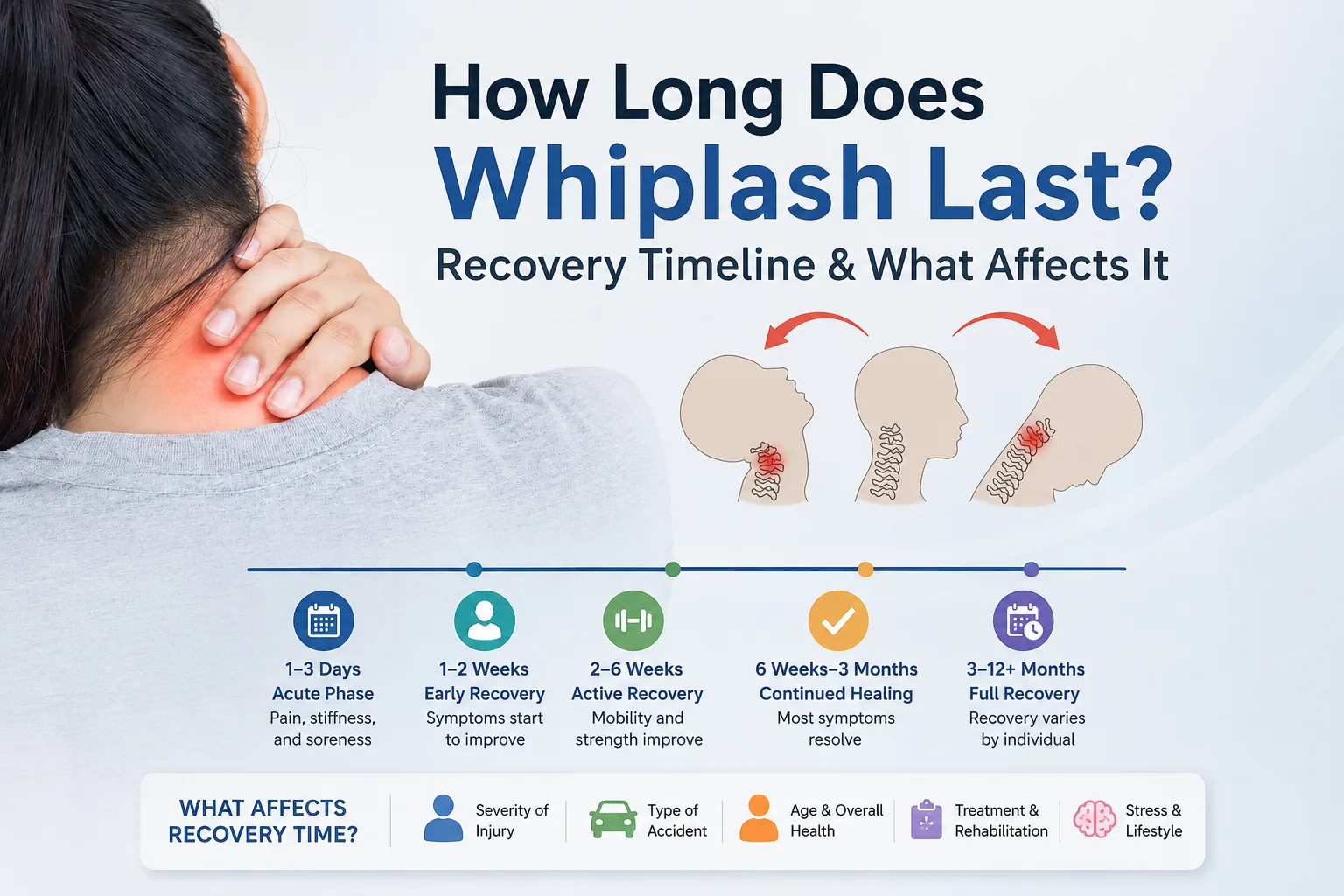
How Long Does Whiplash Last? Recovery Timeline and What Affects It
You’re three days out from a rear-end collision. The neck stiffness that wasn’t there in the ER is suddenly making it hard to turn your head, your sleep is a mess, and at 2 AM you’re searching for the same answer everyone searches for: how long does whiplash last? Most results give you some version of “it depends.” That’s true. But it’s also not very helpful. We’ve been treating whiplash patients at our physical therapy clinic across Texas since 1999, and there’s a much clearer picture we can paint based on what we actually see in clinic every week. The Honest Answer For most people, whiplash lasts 2 to 12 weeks. Mild cases tend to clear in 2 to 4 weeks. Moderate cases settle in 6 to 8 weeks. The ones that hang on past 12 weeks (what doctors call “chronic whiplash”) affect roughly 15 to 30% of patients, and they’re almost always the people who never got the right care early on. That’s the part nobody mentions in your ER discharge papers. Early treatment is the single biggest factor in how long this sticks around. The Recovery Timeline (Realistic Version) Week 1: The “It’s Getting Worse” Phase This catches a lot of people off guard. You walked away from the crash feeling sore but okay. By day 2 or 3, the pain ramps up sharply. This is normal. Adrenaline masks the soft tissue damage at the scene, and inflammation peaks around 48 to 72 hours later. You’ll usually feel: Stiff neck, worst in the morning Headaches at the base of the skull Pain turning your head Tightness through the shoulders and upper back Weeks 2 to 4: The “Am I Getting Better?” Phase If you started PT in week one, you’re noticing real improvements by now. Sleep gets easier. You can drive without wincing. If you didn’t start treatment, this is the danger zone. The body begins compensating by tightening surrounding muscles to protect the injured tissues. That tension feels like “I healed but I’m still tight,” and it becomes the foundation for chronic pain later. Weeks 4 to 8: The Recovery Window Most people return to normal in this window IF they’ve been getting hands-on care. Strength returns, stiffness fades, headaches taper off. Most of our patients wrap up active treatment somewhere in here. Beyond 12 Weeks: Chronic Whiplash Territory Pain past three months isn’t healing tissue anymore. It’s a pattern. The nervous system has gotten used to firing pain signals from those areas, and the muscles have rebuilt themselves around the injury. Harder to undo, but still very much treatable. 5 Factors That Affect How Long Whiplash Lasts How quickly you start treatment. Patients who begin whiplash physical therapy within the first 7 to 14 days recover noticeably faster than those who wait. By far the biggest factor. The severity of the impact. A 15 mph fender-bender heals differently than a 45 mph rear-end at a stoplight. Your age and baseline health. A 28-year-old typically recovers faster than a 58-year-old. Pre-existing neck issues like arthritis stretch the timeline. Whether you keep moving. Resting too much actually slows recovery. Guided, gentle motion stops the stiffness from cementing. Your stress level. Sounds soft, but the research backs it up. High stress keeps muscles braced, which compounds the injury. How Whiplash Physical Therapy Treatment Speeds Recovery A solid whiplash physical therapy treatment plan handles three things at once: pain reduction early, restoring movement in the middle weeks, and rebuilding strength in the final weeks. Our outpatient physical therapy services for whiplash patients include: Hands-on manual therapy to release tight tissue and restore joint motion Specific neck and postural exercises (not generic YouTube stretches) Dry needling for the trigger points that almost always develop in the upper trap and levator scapulae Education on driving, sleeping, and work postures that prevent reinjury A typical patient comes in within the first 10 days post-accident, sees us 2 to 3 times a week for the first month, then tapers to weekly visits as range of motion returns. Most are discharged with a home exercise program around week 6 to 8. The goal is to get you back to your life, not keep you on a treatment table for months. One Texas-specific note: you don’t need a doctor’s referral to start physical therapy treatment for whiplash here. If you have PIP insurance from the accident, it usually covers the entire treatment plan. We handle the paperwork. When to Get Checked Out Right Away Some symptoms aren’t just whiplash. Call your doctor or come in to get checked if you have: Numbness or weakness in your arms or hands Severe headaches that get worse over time Memory issues, confusion, or trouble concentrating Persistent dizziness or balance problems Vision changes or ringing in your ears These point to possible nerve involvement or concussion, both of which need a closer look. Frequently Asked Questions How long does whiplash last? Most whiplash recovers in 2 to 12 weeks. Mild cases clear in 2 to 4 weeks, moderate cases in 6 to 8 weeks. Around 15 to 30% of patients develop chronic whiplash lasting beyond 12 weeks, usually when early treatment is skipped. When should I start physical therapy after a car accident? The first 7 to 14 days post-accident is the ideal window. Patients who start PT early recover noticeably faster than those who wait. In Texas, you don’t need a doctor’s referral to start. Does PIP insurance cover whiplash treatment in Texas? Yes. Personal Injury Protection (PIP) insurance typically covers physical therapy treatment for whiplash after a car accident in Texas. Exact coverage depends on your policy limits, but most plans cover the full treatment course. What’s the difference between acute and chronic whiplash? Acute whiplash is the inflammatory injury and tissue damage from the accident itself, usually resolving in 2 to 12 weeks. Chronic whiplash is pain lasting beyond 12 weeks, where the nervous system and muscles have adapted around the injury rather than healing from
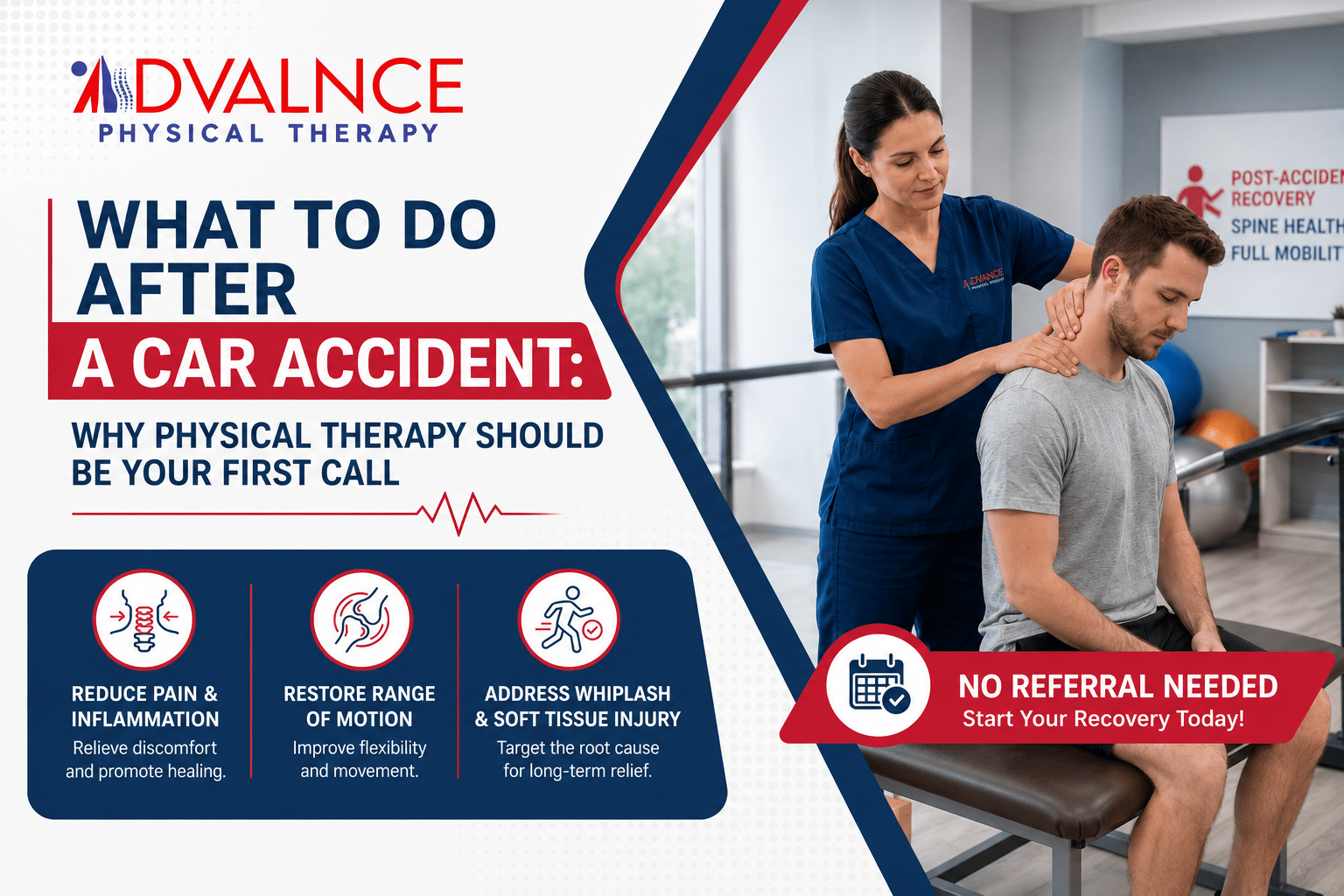
What to Do After a Car Accident: Why Physical Therapy Should Be Your First Call
Every year, thousands of Texans walk away from a car accident thinking they are completely fine — only to wake up days later barely able to get out of bed. If you have been in a motor vehicle accident (MVA), getting a physical therapy evaluation is not just a smart idea. It is the single most important step you can take for your health, your recovery, and your legal rights. Whether your accident happened in Duncanville, East Houston, Baytown, Cypress, Irving, Sugar Land, Richmond, or College Station, Advance Physical Therapy has a clinic near you — ready to see you without a referral. Why Physical Therapy Should Be Your First Call After a Car Accident After a collision, most people do one of three things: they rush to the emergency room for immediate trauma care, they wait to “see how they feel over the next few days,” or they start searching online for a car accident chiropractor near me. Here is what most people do not know: a licensed Doctor of Physical Therapy (DPT) is specifically trained to identify, diagnose, and treat the exact types of musculoskeletal injuries caused by auto accidents — including whiplash, disc injuries, soft tissue damage, nerve compression, and joint trauma. Emergency rooms are absolutely essential for life-threatening injuries. But for the vast majority of car accident injury treatment, a physical therapist offers something an ER simply cannot: a full movement-based evaluation, a personalized recovery plan, and documented clinical records that protect your insurance claim and personal injury case. The Adrenaline Trap — Why You Feel “Fine” Right Now In the minutes and hours after a crash, your body floods with adrenaline and cortisol — powerful stress hormones that temporarily shut down your pain receptors. You may feel shaken, but physically okay. This is completely normal — and completely misleading. Many serious car accident injuries, including whiplash, herniated discs, nerve damage, and soft tissue tears, do not cause noticeable pain for 24 to 72 hours after the accident — and sometimes weeks later. By the time pain appears, inflammation has already set in and tissue damage has begun. A physical therapy evaluation catches these hidden injuries before they become permanent, chronic conditions. Do not wait for pain to appear. Pain is often the last symptom to show — and the first sign that damage has already been done. Common Injuries Physical Therapy Treats After a Car Accident Auto accident injury treatment covers a wide range of conditions caused by the sudden, high-velocity forces of a motor vehicle collision. At Advance Physical Therapy, our DPT-credentialed therapists specialize in all of the following: Injury Type What Happens Why PT Helps Whiplash & Neck Pain Rapid back-and-forth movement damages cervical muscles, tendons, and discs Manual therapy + targeted exercise restores neck mobility and reduces pain Lower Back & Disc Injuries Lumbar spine absorbs massive impact force, causing herniated or bulging discs Spinal decompression, core strengthening, and manual techniques relieve pressure Concussion & Head Injuries Even minor head impact causes dizziness, brain fog, and headaches Specialized vestibular rehab restores balance and reduces concussion symptoms Shoulder & Rotator Cuff Bracing against dashboard or gripping wheel tears shoulder tendons Targeted rotator cuff rehab rebuilds strength and restores full range of motion Knee & Leg Injuries Dashboard impact causes meniscus tears, sprains, and ligament damage Progressive strengthening and manual therapy restores full knee function Soft Tissue & Nerve Pain Widespread muscle strains, ligament sprains, and nerve compression Hands-on manual therapy, stretching, and neuromuscular re-education reduce pain ⚠️ Warning Signs to Watch For After Your Car Accident Do not ignore these symptoms in the hours and days following your accident. These are your body’s signals that an injury has occurred — even if you feel “mostly okay” right now: Neck stiffness or pain that gets worse when you try to turn your head Headaches that begin at the base of your skull — a classic whiplash sign Tingling, numbness, or weakness running down your arms, hands, or legs Lower back tightness or pain that was not present before the accident Dizziness, poor balance, or a persistent “foggy” feeling Shoulder pain or difficulty raising your arm above shoulder height Difficulty sleeping because of muscle spasms, aching, or nerve pain Knee swelling, clicking, or instability when walking or climbing stairs If you notice any of these symptoms after an auto accident in Texas, call Advance Physical Therapy immediately. No referral needed — we can see you today. What to Do Immediately After a Car Accident in Texas Follow these steps to protect both your health and your legal rights after any motor vehicle accident: Step 1 — Call 911 and Document Everything File a police report at the scene. This document is critical for your insurance claim and any personal injury case. Photograph vehicle damage, road conditions, and any visible injuries. Step 2 — Seek Medical Care Within 24 Hours Even if you feel okay, see a healthcare provider the same day or the following morning. In Texas, delaying medical care — even by just a few days — can significantly weaken your PIP insurance claim. Step 3 — Call Advance Physical Therapy (No Referral Required) Under Texas law, you can begin car accident physical therapy without a doctor’s referral for up to 10 days. All Advance Physical Therapy clinicians hold doctoral DPT degrees, meaning you receive the highest level of physical therapy care from your very first visit. We will evaluate your injuries and build your personalized recovery plan immediately. Step 4 — File Your PIP Insurance Claim Texas Personal Injury Protection (PIP) insurance covers your physical therapy costs regardless of who caused the accident. Our team assists you with the entire insurance process — paperwork, billing, and coordination with your insurance company — so you can focus entirely on healing. Step 5 — Keep Every Record Your physical therapy appointment records are among the most powerful forms of evidence in a Texas personal injury case. Every session creates a documented clinical paper trail
IT Band Syndrome Symptoms: 7 Warning Signs You Should Never Ignore
If you feel pain on the outside of your knee during walking, running, or climbing stairs, you may be dealing with Iliotibial Band Syndrome (IT Band Syndrome). It’s a common overuse injury that affects runners, cyclists, athletes, and even people with physically demanding jobs. The tricky part is that it usually starts small — a little twinge you can easily brush off — and slowly turns into pain that follows you every time you get active. Ignoring those early symptoms can make the condition worse and lead to chronic pain or limited mobility. The good news: caught early, it responds really well to treatment. And at Advance Physical Therapy, you don’t need a referral to get started with outpatient physical therapy. 🦵What Is IT Band Syndrome? The iliotibial band (IT band) is a thick band of connective tissue that runs from your hip down to the outside of your knee. Its job is to stabilize the knee and support leg movement. When the IT band becomes tight or irritated, friction builds up near the knee joint, causing inflammation and pain. That’s what we call IT Band Syndrome. ⚠️Top 7 IT Band Syndrome Symptoms 1Pain on the Outside of the Knee This is the most common symptom. It usually starts as mild discomfort and gradually gets sharper during activity. Most people notice it while: Running Walking long distances Climbing stairs Cycling 2Pain That Gets Worse During Exercise IT band pain often builds with repetitive movement. You may feel fine at first, but the pain intensifies the longer you stay active — something runners and cyclists know all too well. 3Tightness Around the Thigh or Hip A tight feeling along the outer thigh or hip can signal IT band irritation. Tight hip muscles often add extra stress to the knee. Stretching alone may not fully fix it if muscle weakness or movement problems are involved. 4Clicking or Snapping Sensation Near the Knee Some people feel a snapping sensation when bending or straightening the knee. This happens when the tight IT band rubs against the outer knee. Left untreated, the inflammation tends to increase over time. 5Tenderness When Touching the Knee The outside of the knee may feel sore or sensitive to pressure. Even simple daily activities can start to feel uncomfortable as the irritation worsens. 6Swelling or Inflammation Swelling is usually mild, but inflammation around the outer knee can show up in more severe cases. It may also cause stiffness after exercise or after sitting for a long time. 7Reduced Mobility or Weakness As pain increases, many people start avoiding movement without even realizing it. That can lead to muscle weakness, poor balance, and reduced flexibility — and without proper treatment, the problem keeps coming back. 🔍What Causes IT Band Syndrome? It’s almost always an overuse problem rather than a single injury. Common contributors include: Overuse from running or cycling Poor running mechanics Weak hip muscles Tight muscles around the hip and thigh Sudden increases in activity level Improper footwear 💡 Why rest alone often isn’t enough: If weak hips or poor movement mechanics caused the problem, the pain usually returns the moment you get active again — unless that underlying weakness is addressed. 🩺How Is IT Band Syndrome Diagnosed? A physical therapist or healthcare provider typically diagnoses IT band syndrome through a physical examination, movement assessment, pain-location evaluation, and flexibility testing. In some cases, imaging tests are recommended to rule out other knee conditions. 💪How Physical Therapy Helps IT Band Syndrome Physical therapy treats both the pain and the underlying movement problems causing it. If your symptoms aren’t settling on their own, our therapists provide hands-on iliotibial band syndrome treatment built around your specific case — not a generic stretch sheet. A typical plan may include: Stretching exercises Hip and leg strengthening Manual therapy Movement correction Balance and mobility training Personalized recovery programs 🧘Best Exercises and Stretches for IT Band Syndrome Standing IT Band Stretch Glute Strengthening Exercises Foam Rolling Hip Mobility Exercises A licensed outpatient physical therapy provider can create a customized exercise plan based on your symptoms and activity level. ⏱️IT Band Syndrome Recovery Timeline Recovery time depends on how severe the condition is and how early treatment begins. Mild cases: 2–4 weeks Moderate cases: 4–8 weeks Chronic cases: several months Consistent treatment, the right exercises, and activity modification usually improve recovery outcomes. ❓IT Band Syndrome: Questions Patients Ask Us Most How long does IT band syndrome take to heal? A mild case caught early often eases in a few weeks with the right activity changes and exercises. Chronic cases that have gone on for months can take six weeks or longer, and they respond best to a proper plan rather than rest alone. The biggest factor is whether you fix the underlying hip and glute weakness that started it. Should I keep running with IT band pain? No — running through it usually makes it worse and drags recovery out. That sharp outer-knee pain is friction building up, and every stride adds to it. Back off running for a while, swap in low-irritation activity if you need to stay active, and get the cause treated. Most runners come back faster by resting it early than by pushing through. IT band vs meniscus — how do I tell the difference? IT band pain sits on the outside of the knee, feels sharp or burning, shows up a set distance into activity, and eases with rest. Meniscus problems usually cause pain deeper inside the knee joint, often with clicking, locking, catching, or swelling, and sometimes start after a twist or injury rather than overuse. If your knee locks, gives way, or swells, get it assessed to rule out a meniscus issue. What is the best treatment for IT band syndrome? The best treatment fixes why it started, not just the symptoms. That means easing off the aggravating activity for a while, hands-on manual therapy to calm the irritated tissue, and a strengthening program for the hips, glutes, and core

Dry Needling vs Acupuncture for Back Pain: Which One Actually Works Faster?
Back pain has a way of making you try anything. And at some point, someone probably suggested either acupuncture or dry needling — or maybe both. Both use thin needles. Both are known to relieve pain. But if you’re dealing with a bad back right now, you don’t have time for a slow fix. So the real question is: between dry needling vs acupuncture, which one actually gets you out of pain faster? In this article, we’ll break down exactly how each treatment works, compare the evidence, and give you a straight answer — based on the type of back pain you have. No fluff, no vague “it depends.” Just clear, useful information from the physical therapists at Advance Physical Therapy. Quick Answer: For muscle-related or acute back pain, dry needling therapy typically produces faster relief (often within 1–3 sessions). For chronic, systemic, or stress-driven back pain, acupuncture can be equally effective — or better. Read on for the full breakdown. What Is Dry Needling? Dry needling is a modern physical therapy technique based on Western anatomy and neuroscience. A licensed physical therapist inserts a thin, sterile filament needle directly into a muscle trigger point — those tight, painful knots you can feel in your lower back or shoulders. The moment the needle reaches the trigger point, it provokes a brief involuntary muscle twitch. That twitch is actually a good sign — it means the muscle is releasing its tension. Blood flow increases to the area, inflammation begins to resolve, and your body kicks into healing mode. If you’re searching for dry needling near me, it’s worth knowing that dry needling treatment is typically performed by physical therapists — not acupuncturists — and is rooted in evidence-based medicine, not traditional Eastern philosophy. Dry needling therapy works especially well for: Lower back muscle knots and myofascial trigger point pain Acute back strains from lifting, sports, or sudden movements Upper and lower back stiffness from prolonged sitting or poor posture Sciatica pain with a muscular component Sports injuries and post-activity soreness What Is Acupuncture? Acupuncture is a 2,500-year-old healing practice from Traditional Chinese Medicine (TCM). Needles are placed at specific points along energy pathways called meridians to restore the flow of Qi — the body’s vital energy. From a modern scientific standpoint, acupuncture stimulates nerve endings, triggers the release of natural pain-relieving chemicals (endorphins), and can reduce systemic inflammation. Whether you subscribe to TCM philosophy or not, the physiological effects are well-documented. Sessions tend to be longer and more meditative — needles are typically retained for 20 to 45 minutes, and the treatment addresses the whole body, not just the site of pain. Acupuncture works best for: Chronic lower back pain that has persisted for months or years Back pain linked to stress, anxiety, or poor sleep Systemic inflammation and nerve-related pain Patients looking for a holistic, whole-body approach Conditions involving multiple body systems alongside back pain Dry Needling vs Acupuncture: The Key Differences At first glance, acupuncture vs dry needling looks identical — same thin needles, same general idea. But the differences go much deeper than the surface. Here’s how they compare across the factors that matter most: Factor Dry Needling Acupuncture Origin Western Medicine (1940s) Traditional Chinese Medicine (2,500+ yrs) Basis Anatomy & neurophysiology Energy meridians (Qi) Performed by Licensed Physical Therapist Licensed Acupuncturist Target Muscle trigger points / knots Meridian points across the body Session length 15–30 minutes 45–60 minutes Speed of relief Often 1–3 sessions ✓ Usually 4–8 sessions Best for Acute muscle pain, sports injuries Chronic pain, stress-related issues Insurance Usually covered via PT plan Varies by plan The most important distinction? Dry needling targets specific muscle trigger points using anatomy-based precision. Acupuncture targets energy points along meridians to influence the body’s overall balance. Same tool. Completely different map. Which Works Faster for Back Pain? (Honest Answer by Pain Type) This is the question everyone actually wants answered. And the honest truth is — the faster treatment depends entirely on what’s causing your back pain. Here’s a clear breakdown: Back Pain Type Dry Needling Acupuncture Muscle knot / Trigger point pain 1–2 sessions 3–5 sessions Post-workout / sports injury 1 session (very fast) 3–4 sessions Acute lower back strain 2–4 sessions 4–6 sessions Sciatica with muscle involvement 3–5 sessions 5–8 sessions Chronic back pain (6+ months) 3–6 sessions Equally good, holistic Stress-related back tension Helps the muscle component Better overall approach The Pattern: Dry needling treatment vs acupuncture shows a consistent speed advantage when the cause is muscular. That’s because dry needling goes directly to the source — the tight, overloaded muscle — and releases it mechanically. Acupuncture works at a broader neurological level, which takes more time to accumulate. Why Does Dry Needling Work Faster for Most Back Pain? Most back pain — whether it’s from sitting at a desk all day, a weekend workout gone wrong, or years of poor posture — has a significant muscular component. That tight, achy lower back you feel? Chances are there are trigger points in your lumbar muscles that are holding that tension. Dry needle therapy goes directly to those points. The needle causes an immediate twitch response that resets the muscle’s resting tension, increases blood flow, and accelerates recovery. Many patients notice a significant difference within 24–48 hours of their first session. Acupuncture, by contrast, works by stimulating the nervous system globally. It’s an accumulative process — each session builds on the last. For chronic conditions, this is actually a strength. But for an acute back muscle problem, you’re waiting longer for results that dry needling can often deliver in one or two visits. What Does the Research Say? Evidence for Dry Needling A 2023 umbrella review covering 36 systematic studies confirmed that dry needle vs acupuncture research consistently shows dry needling outperforming no treatment

I Was Just in a Car Accident in Houston — What Should I Do First?
A car crash can happen in seconds — but the decisions you make in the hours and days that follow can determine whether you fully recover or live with pain for years. Whether it was a fender-bender at a stoplight in Cypress or a high-speed highway collision near East Houston, the moments after a car accident are overwhelming. This guide breaks down exactly what steps to take, why physical therapy should be at the top of your list, and how Advance Physical Therapy helps hundreds of Houston-area car accident victims recover fully — every single year. ⚠️ CRITICAL WARNING: Do Not Ignore This Many car accident victims feel “okay” right after the crash — and skip medical care. This is one of the biggest mistakes you can make. Adrenaline masks pain. Many serious injuries — whiplash, herniated discs, spinal damage, soft tissue tears — don’t show up until 24 to 72 hours later, or even weeks after the accident. By then, the damage may have worsened significantly. Your 6 Most Important Steps After a Car Accident 1 Call 911 & Ensure Safety Move to safety if possible. Call 911 even if injuries seem minor. A police report creates an official record — this is essential for insurance and any future legal claims. 2 Seek Medical Attention Immediately Go to the ER or urgent care right away, even if you feel fine. Many internal injuries, spinal issues, and concussions show no immediate symptoms but can be life-altering if untreated. 3 Document Everything Take photos of the accident scene, your vehicle, and any visible injuries. Get the other driver’s insurance details, witness contacts, and note the exact date, time, and location. 4 Contact Your Insurance Company Report the accident to your insurance provider as soon as possible. In Texas, Personal Injury Protection (PIP) covers your medical expenses — including physical therapy — regardless of who was at fault. 5 Consult a Personal Injury Attorney (If Needed) If the other driver was at fault, consider consulting a Texas personal injury attorney. Documented physical therapy is one of the strongest ways to support your injury claim and increase your settlement value. 6 Start Physical Therapy — This Week Do not wait. Research shows that starting PT within the first week gives you the best chance of full recovery. Call Advance Physical Therapy today — no referral required in Texas for the first 10 days. Why Symptoms Often Appear Days Later — And Why That’s Dangerous Here’s something most people don’t know: the absence of immediate pain does NOT mean you’re uninjured. After a car crash, your body floods with adrenaline and cortisol — natural stress hormones that temporarily suppress pain signals. Many car accident victims walk away from the scene feeling shaken but physically fine — and skip medical care entirely. Days later, they’re barely able to get out of bed. ⚡ Delayed Injury Warning Signs — Watch for These in the Days After Your Accident Neck pain or stiffness appearing 24–72 hours later — classic whiplash symptom Back pain or tightness — may indicate muscle strain, herniated disc, or spinal misalignment Headaches starting the day after — could signal concussion or cervical nerve injury Numbness or tingling in arms, hands, legs — nerve compression warning Shoulder pain or weakness — common from seatbelt impact or bracing during crash Dizziness or balance problems — sign of vestibular or inner ear injury Difficulty sleeping or concentrating — possible traumatic brain injury (TBI) symptom Jaw pain or clicking — TMJ injury from impact force “Studies show that up to 70% of car accident victims who don’t receive early physical therapy go on to experience chronic, long-term pain — often lasting years.” What We Treat Most Common Car Accident Injuries We Treat in Houston 🔄 Whiplash & Neck Pain The #1 injury in car accidents. Caused by rapid back-and-forth neck movement. Leads to stiffness, headaches, and limited range of motion if untreated. 🦴 Back Pain & Herniated Discs Impact forces compress the spine, causing disc herniation, lower back strain, and nerve irritation that radiates into the hips and legs. 🧠 Concussion & Head Injuries Even without direct head impact, the violent movement of a crash can cause traumatic brain injuries, dizziness, memory issues, and headaches. 💪 Shoulder & Rotator Cuff Injuries Seatbelts and bracing impact cause significant shoulder strain. Without proper PT, these often develop into chronic pain and restricted movement. 🦵 Knee Injuries & Sprains Dashboard impact, sudden braking, and crash forces commonly injure the knee ligaments, meniscus, and surrounding soft tissue. 🫀 Soft Tissue Injuries Muscles, ligaments, and tendons throughout the body suffer strains, tears, and contusions — often invisible on X-rays but causing significant pain. ⚡ Nerve Damage & Sciatica Spinal compression from the accident can pinch nerves, causing radiating pain, tingling, numbness, or burning sensations down the arms or legs. 😵 Vestibular / Balance Problems Inner ear disruption from crash impact causes dizziness, vertigo, and balance issues — conditions specialized vestibular PT can resolve effectively. Recovery Timeline When Should You Start Physical Therapy After a Car Accident? The answer is simple: as soon as medically possible. Here’s what the research tells us about timing and recovery outcomes: Day 1–3 Immediately After the Accident Seek emergency medical care. Even if you feel okay, get evaluated. Note all symptoms — even minor ones. Adrenaline is masking your pain right now. Call Advance Physical Therapy to schedule your evaluation for as early as the same week. Week 1 🏆 Ideal: Start PT This Week Starting physical therapy within the first 7 days gives you the best recovery outcomes. In Texas, you can be seen by a licensed Doctor of Physical Therapy for up to 10 days without a doctor’s referral. Early PT prevents acute injuries from becoming chronic conditions. Week 2–4 Still Good — Don’t Wait Any Longer If you haven’t started yet, this is your final window before acute injuries begin to harden into chronic pain. Inflammation sets in, scar tissue begins forming, and