
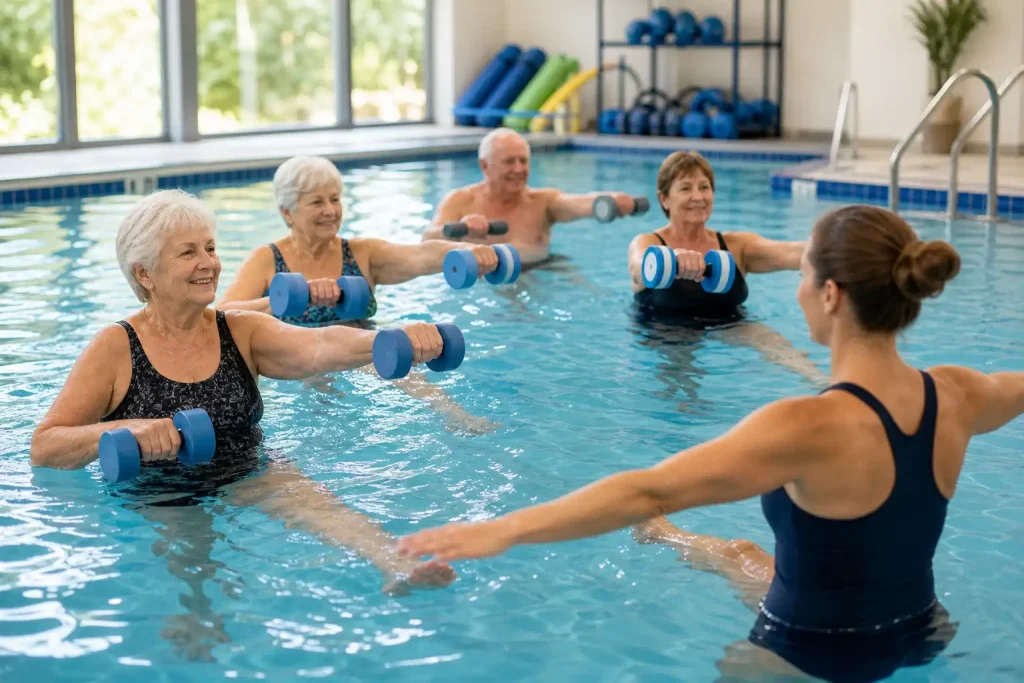
Water Exercises for Seniors: A Balance and Strength Pool Routine From a PT
You hold the counter a little longer when you stand up. Curbs look taller than they used to. Maybe you’ve quietly stopped walking on the uneven sidewalk down the street. That’s usually how balance loss starts. Water exercises for seniors let you practice the moves that feel risky on land, like standing on one leg or turning around. The water slows you down and catches you if you wobble. The most useful water exercises for seniors pair leg strengthening with balance challenges. Think water walking, heel raises, side steps, mini squats, and single-leg stands, done in waist- to chest-deep water two to three times a week. Buoyancy eases joint load. Resistance and slower movement give older adults more time to recover from a wobble. Leg strength and balance tend to decline together, so training both at once makes sense. A 2020 systematic review of 11 randomized trials in adults 65 and older, published in BMC Geriatrics, found aquatic and land exercise improved dynamic balance by similar amounts. The pool is a legitimate place to begin. Why Water Changes the Balance Equation, and Where It Falls Short Water helps balance training because it slows movement, supports part of your weight, and pushes back from all sides. A stumble becomes a sway you can recover from. That extra reaction time lets you practice drills you’d avoid on a hard floor. What most pool guides skip is that depth works like a dial with two settings pulling against each other. Deeper water takes more load off sore knees and hips. But it also lightens your feet on the pool floor, which makes standing still harder. Commonly cited estimates from Harrison and Bulstrode’s hydrotherapy pool research show the trade-off: Water depth Approximate body weight on your legs Best used for Waist-deep Roughly 50–60% Strength work, step-ups, early balance drills Chest-deep Roughly 25–40% Painful knees or hips, wall-supported drills Neck-deep Around 10% Too buoyant for most standing balance work Water has limits, too. It doesn’t load your bones the way walking on land does. And because it’s so forgiving, your ankles never practice reacting to a hard surface. Treat the pool as a starting point, not the whole program. Beginner Water Exercises for Seniors: The Wall-Supported Stage The beginner stage uses five exercises with one hand on the pool edge for every move. Aim for two or three sessions a week of roughly 20 to 30 minutes. Warm up with a few minutes of easy water walking. Exercise How to do it Reps What it builds Water walking Walk forward along the wall, rolling from heel to toe, then walk backward 2–4 laps each way Stride length, ankle control Heel raises Face the wall, rise onto your toes, lower slowly 10–15 Push-off strength for catching a stumble Side steps Face the wall and step sideways, toes pointing forward 2 laps each way Hip muscles that resist sideways falls Mini squats Sit back a few inches as if toward a chair, then stand 10–12 Sit-to-stand strength Leg swings Side to the wall, swing one leg forward and back, then sideways 10 each way per leg Single-leg stance control The common mistake here is speed. Water resistance climbs steeply as you move faster, so quick, splashy reps mostly train momentum. Slow reps with a short pause build the control you’ll actually use on a curb. Intermediate Stage: Letting Go of the Wall Move on only when you can finish the beginner routine without grabbing the wall to catch yourself. Then change one thing at a time: less hand support, a narrower stance, added movement. In practice, these are good signs you’re ready: Every beginner exercise feels steady with just a fingertip on the wall. You can stand on one leg, fingertip support only, for about 10 seconds per side. Sessions don’t leave your joints sore or your head dizzy. Then swap in these progressions, staying within arm’s reach of the wall: Tandem walking: walk heel to toe in a straight line without touching the wall. Single-leg reaches: balance on one leg and slowly reach forward, then sideways. Marching with turns: march 10 high-knee steps, turn around, and march back. Stair step-ups: hold the pool handrail and step up and down, 8 to 10 times per leg. Walking with head turns: turn your head side to side as you walk, like checking for traffic. Turns and head movement are there on purpose. Balance testing often shows that people who walk a straight line confidently lose steadiness the moment they pivot. If head turns make you dizzy, stop and tell a physical therapist. It can point to an inner-ear problem rather than weak legs. How to Make Pool Balance Carry Over to Dry Land Balance gained in the pool doesn’t automatically transfer to land. Water gives you extra time and support that a kitchen floor won’t. The fix is a short land bridge: within a day of each session, repeat heel raises, side steps, and sit-to-stands at home while holding a sturdy counter. Getting in and out is usually the riskiest part of a pool session. Wet tile, stairs, and the return of your full body weight all arrive at once. Wear water shoes, use the railing, and sit for a minute if you feel lightheaded afterward. Warm water widens blood vessels, and some blood pressure medications add to that effect. Stop and get checked for chest pain, unusual breathlessness, or dizziness. When to See a Physical Therapist Instead of Joining a Class A group water class suits people who are steady on their feet and want to stay active. See a physical therapist first if you’ve fallen in the past year, feel unsteady, or worry about falling. Those three questions mirror the fall-risk screening in the CDC’s STEADI initiative. Your situation Group water class PT-guided aquatic therapy Steady, no falls in the past year Good fit Usually not needed A fall in the past year Not a substitute for an evaluation Recommended first Recent knee, hip, or